Nearby Galaxy Torn Apart by Its Own Supermassive Black Hole
Astronomers have made a stunning discovery. A nearby galaxy is being violently torn apart. Its own supermassive black hole is launching an enormous gas outflow. This event is reshaping the galaxy’s future.The galaxy is named VV 340a. Researchers from UC Irvine led the study. They used NASA’s James Webb Space Telescope for their observations. The findings appear in the journal Science.
An Unprecedented Galactic Outflow
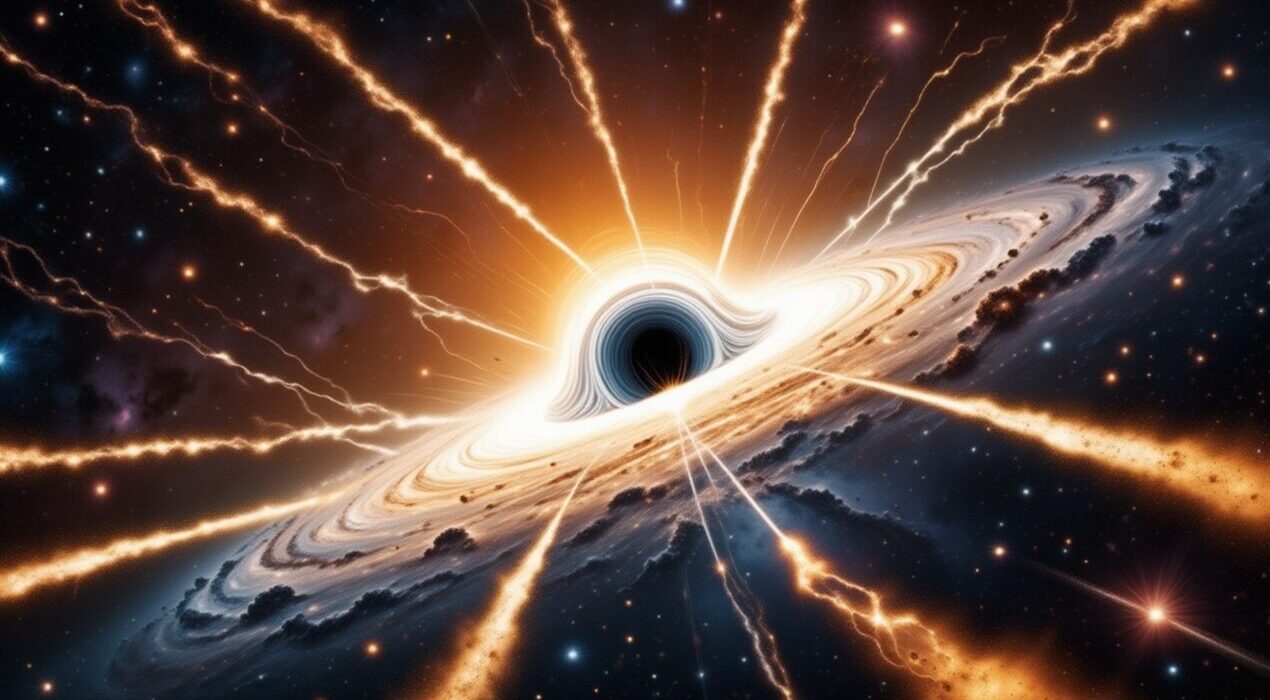
The team found two massive streams of super-heated gas. These streams blast outward from the galaxy’s core. Each stream stretches over 3 kiloparsecs. For perspective, the galaxy’s disk is about the same thickness.This scale is truly remarkable. Typically, such energized gas stays close to the black hole. In this case, it extends 30 times farther than usual. “It was a nice surprise,” said co-author Vivian U.The gas is called “coronal line” gas. It is extremely hot and highly ionized. The energy in this outflow is immense. It equals 10 quintillion hydrogen bombs exploding every second.
The Cause: A Wobbling Jet
What drives this powerful outflow? Data reveals a “precessing” jet from the black hole. This means the jet wobbles like a spinning top. As a result, it sweeps across the galaxy.The jet interacts with the galaxy’s gas. Consequently, it heats the gas and pushes it outward. This process strips away the material needed to form new stars. In fact, it removes enough gas each year to make 19 suns.
How Telescopes Revealed the Mystery
Different telescopes provided key insights. The Webb telescope’s infrared vision was crucial. It peered through dust to see the hot coronal gas.Radio observations showed the twisted plasma jets. Additionally, the Keck telescope revealed cooler gas far from the core. This gas is likely a fossil record of past jet activity.
This event dramatically affects the galaxy. It severely limits star formation. Therefore, the galaxy’s evolution changes course.Our Milky Way likely had similar activity long ago. Studying VV 340a helps us understand our own galaxy’s past and future. The team now plans to search for this phenomenon elsewhere.”These are never-before-seen phenomena,” said U. The discovery showcases the power of new tools like the Webb telescope. It opens a new window into how black holes shape their galaxies.