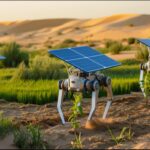
China Deploys Solar Robots to Fight Desertification With Smart Tree Planting
China has introduced a new solution to fight desertification: solar-powered tree planting robots. These machines move across harsh desert terrain and plant seeds directly into the sand. As a result, they help restore damaged ecosystems one step at a time.
Desertification threatens farmland, water supplies, and air quality. Therefore, China continues to invest in large-scale land restoration projects. These robots now support the country’s “Green Great Wall” initiative, which aims to expand forest coverage and prevent soil erosion.Unlike traditional equipment, these robots operate without fuel. They rely on solar panels for power. This makes them self-sustaining in sun-heavy desert regions.
How Solar-Powered Tree Planting Robots Work
The robots use mechanical legs to walk across uneven sand. Each leg performs two functions. First, it provides mobility. Second, it plants seeds or saplings into the ground with precision.Because the design is contact-based rather than wheel-driven, the robots reduce soil disturbance. As a result, they lower erosion risks. In addition, precise planting improves root stability.The system includes built-in hydration techniques. Seeds receive optimal placement and moisture support. Early trials show higher survival rates compared to manual planting methods.Moreover, the robots reduce human exposure to extreme heat. Desert environments can be dangerous and remote. Therefore, automation improves safety while increasing efficiency.
Why This Innovation Matters for Climate and Ecosystems
China faces growing environmental challenges due to expanding deserts. Forest restoration helps stabilize soil and improve air quality. In addition, trees lower surface temperatures and support biodiversity.Solar-powered tree planting robots operate continuously without emitting carbon. This reduces reliance on gas-powered machinery. As a result, the planting process aligns with sustainability goals.Experts believe such robotics could reshape environmental engineering worldwide. Large-scale restoration projects often require heavy labor and time. However, intelligent machines can cover vast areas methodically.
While long-term results require further study, early signs remain promising. If survival rates remain high, these robots could significantly boost reforestation efforts.China’s approach shows how technology and nature can work together. By combining robotics with renewable energy, the country offers a new vision for ecological recovery.In the fight against desertification, innovation is taking root one solar-powered step at a time.