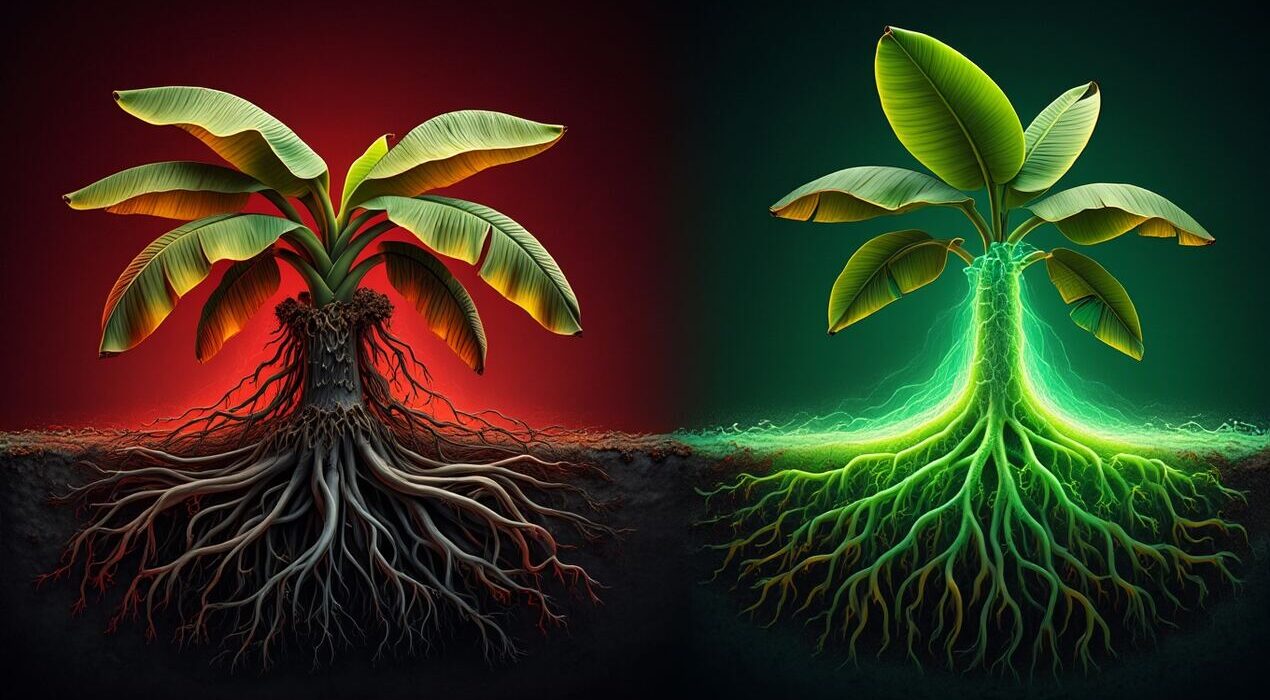
Gene That Could Save Bananas from Deadly Disease Discovered
Fusarium wilt, also known as Panama disease, attacks banana plants through the soil. Infected plants wilt and die completely. Even worse, the fungus contaminates soil for years afterward.This destructive disease threatens Cavendish bananas worldwide. Cavendish varieties are the most commonly eaten bananas globally. Their vulnerability puts a major food source at risk.Dr. Andrew Chen explains: “Identifying natural resistance from wild bananas offers a sustainable solution. This pathogen wilts and kills the host plant while leaving residue in the soil.”
A Wild Relative Holds the Key
The team traced the source of resistance to Calcutta 4—a wild diploid banana. Although inedible, this wild relative carries powerful genetic protection.Researchers crossed Calcutta 4 with susceptible bananas from another subspecies. This process helped them pinpoint the exact protective trait.After growing new plants, scientists exposed them to the deadly fungus. They then compared DNA from plants that survived against those that died.”We mapped STR4 resistance to chromosome 5 in Calcutta 4,” Dr. Chen said. “This is a very significant finding. It represents the first genetic dissection of Race 4 resistance from this wild subspecies.”
Five Years of Painstaking Research
The project required five years of dedicated work. Each banana generation needed at least 12 months to grow. Researchers could only test for disease resistance after flowering occurred.The team combined several advanced techniques. These included forward genetics, genome sequencing, and bulked segregant analysis. Their patience finally paid off with this breakthrough discovery.
From Discovery to Your Fruit Bowl
Calcutta 4 provides crucial genetic resistance. However, it cannot become a commercial cultivar. The wild banana simply doesn’t produce edible fruit.Therefore, the next phase focuses on practical breeding tools. Researchers will develop molecular markers to track the resistance trait efficiently.”These markers will help breeders screen seedlings early and accurately,” Dr. Chen notes. “This speeds up selection, reduces costs, and leads to better bananas.”The ultimate goal is clear. Scientists want a banana that tastes delicious, grows easily, and resists Fusarium wilt naturally.
What Happens Next
STR4 currently affects banana crops in subtropical regions worldwide. It is closely related to Tropical Race 4, which impacts Australian farms.Hort Innovation funded this study through banana industry levy funds. The Australian Government also contributed to the research.The findings now appear in Horticulture Research. These results will guide future investments in banana breeding programs. Scientists hope to turn these genetic discoveries into practical tools soon.For banana lovers everywhere, this research offers genuine hope. The world’s favorite fruit may yet be saved.