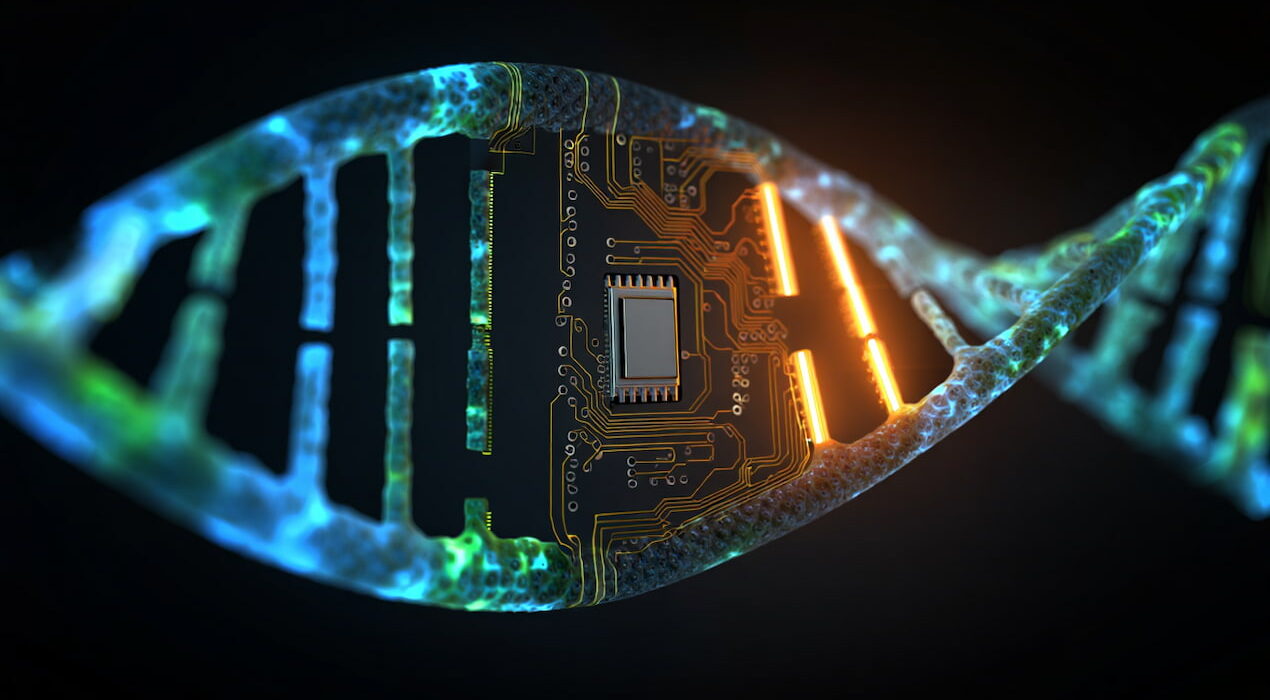
DNA Meets Electronics – Ultra-Low Power Memory Breakthrough
Scientists are merging biology with electronics. This unlocks new possibilities for data storage. DNA carries genetic instructions. But it also stores information very densely. One gram of DNA holds roughly 215 million gigabytes.Now, researchers at Penn State have found a way to connect DNA with electronic systems. Their work appears in Advanced Functional Materials. A patent application is underway.
How the New Memory Works
The team built a device called a memristor. It is a memory resistor. Traditional resistors lose data when power turns off. Memristors do not. They remember the direction of previous current. Therefore, they work like neurons in the human brain.The device has two main parts. One is synthetic DNA. Chemically engineered short sequences make it easy to control. The other is crystalline perovskite. This semiconductor is common in solar cells and lasers.The researchers added silver nanoparticles to the DNA. Then they combined it with thin perovskite layers. This technique is called doping. It helps the DNA conduct electricity. It also makes the structure more organized.
Better Than Flash Drives
This new device consumes 100 times less power than traditional storage. Flash drives use much more energy. In addition, the memory capacity is higher. As a result, it is perfect for AI and neuromorphic computing.The device works with less than 0.1 volt. For comparison, a standard U.S. outlet uses 120 volts. It also stays stable at 250 degrees Fahrenheit. At room temperature, it works for more than six weeks.Using DNA or perovskite alone did not work as well. “It’s this combination that enables very high memory storage density with very little power,” says researcher Kavya Keremane.Nature provides elegant solutions. Scientists just need to find and apply them. This breakthrough shows what becomes possible when biology meets electronics.