Earth and Moon: Then vs Now Explained in Simple Terms
The Earth and the Moon have changed a lot over time. Today, they look calm and stable. However, their early history was far more dramatic.
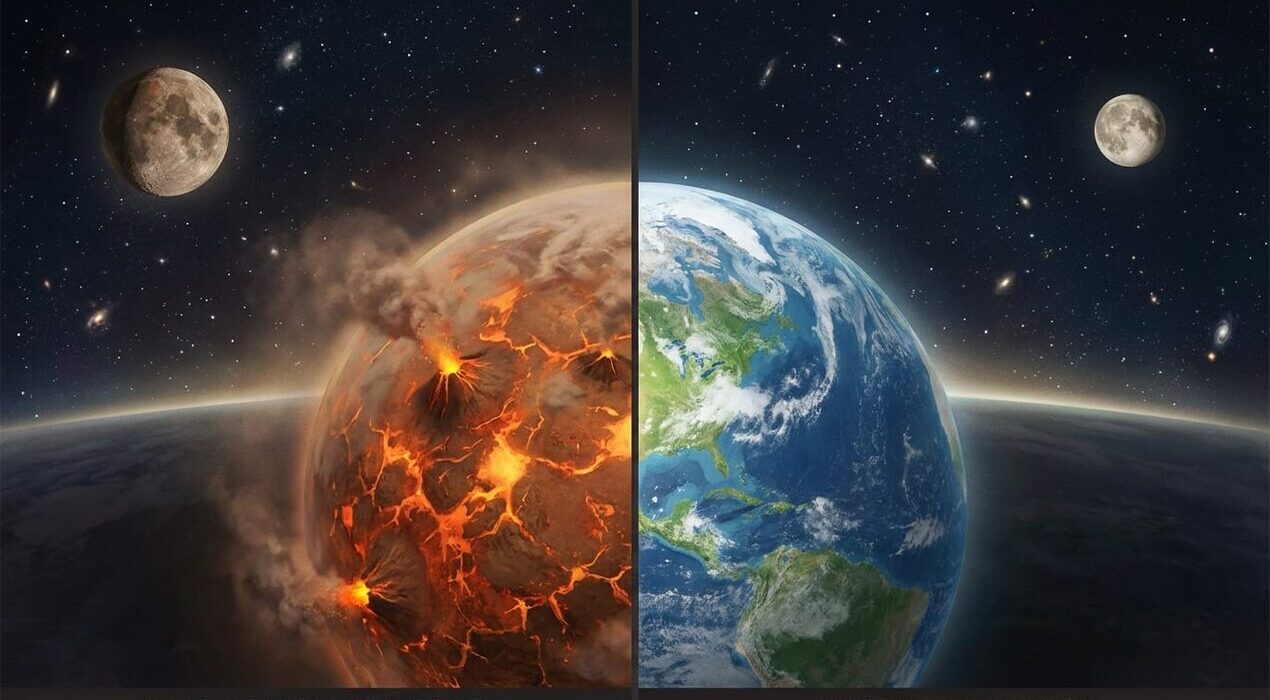
Scientists believe the Moon formed after a massive collision. A Mars-sized object struck early Earth billions of years ago. As a result, debris from the impact came together to form the Moon. This event shaped both worlds in lasting ways. At that time, Earth was extremely hot. Its surface was covered with molten rock and constant volcanic activity.
What the Early Moon Was Like
The early Moon looked very different from today. It had a surface filled with flowing lava. In addition, it was much closer to Earth. This made it appear larger in the sky than it does now. Strong gravitational forces also caused intense tides on Earth. Therefore, early oceans moved in dramatic ways.
How Things Changed Over Time
Over billions of years, both bodies cooled down. Earth developed oceans, continents, and an atmosphere. As a result, life became possible on Earth. Meanwhile, the Moon lost its internal heat and became geologically inactive. In addition, the Moon slowly moved farther away from Earth. Even today, it drifts away by a few centimeters each year.
Earth and Moon Today
Today, Earth supports a wide range of life. It has stable weather systems and flowing water. The Moon, however, is dry and quiet. It has no atmosphere and experiences extreme temperatures. Despite these differences, the Moon still plays an important role. It helps stabilize Earth’s tilt and influences ocean tides. Understanding this history helps scientists learn more about planets. It also shows how rare and special Earth is. For example, the Moon’s presence may have helped life develop. Without it, Earth could be very different.
The story of Earth and the Moon is one of change. From chaos to stability, both have evolved over time. As a result, they continue to shape each other even today.