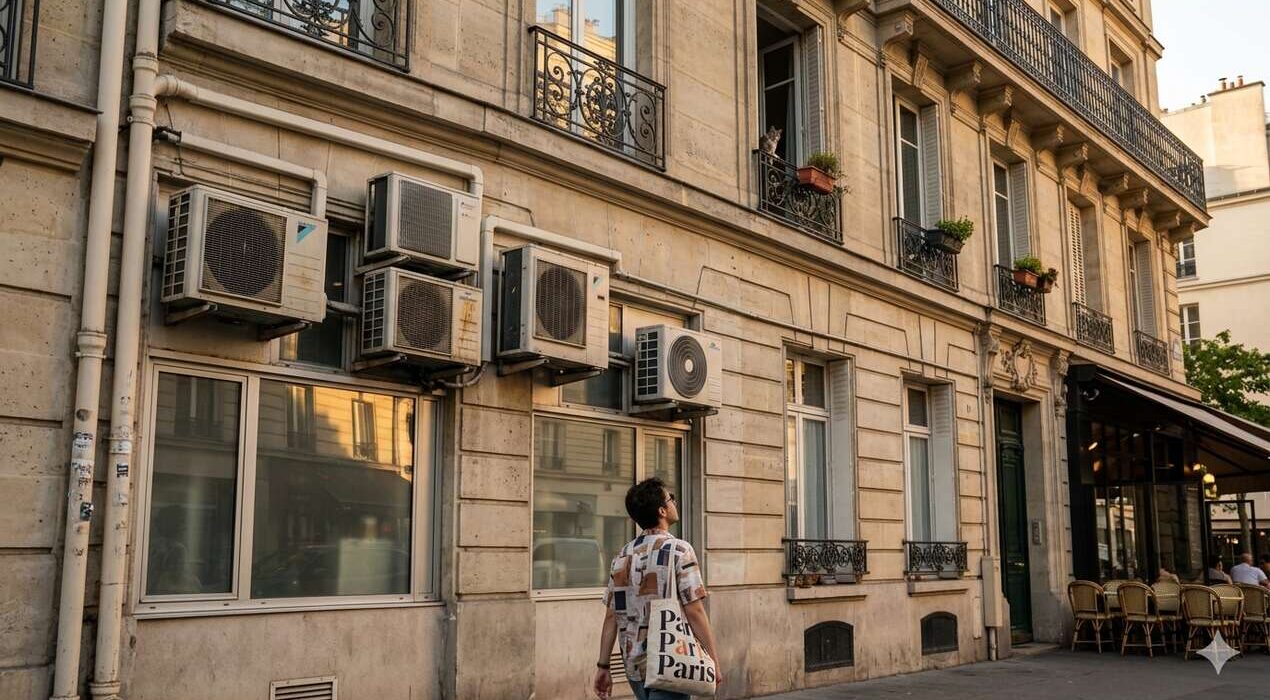
France Air Conditioning Divide Heats Up Debate
France Air Conditioning Divide: A Political Battle
The France air conditioning divide has moved firmly into the public spotlight. Temperatures recently approached 40°C across the country, while Tuesday became one of France’s hottest days on record. As a result, the debate over cooling and climate adaptation has intensified.
Marine Le Pen now advocates a large-scale subsidised rollout of air-conditioning systems. Her right-wing party supports broader access to cooling for households nationwide. Meanwhile, Greens who traditionally opposed air conditioning have softened their stance, acknowledging that some level of cooling may be unavoidable in a warming climate. This marks a significant political shift.
Low Adoption Rates
Currently, only 25% of French homes have air-conditioning units. Spain and Italy have roughly twice that rate, while the United States and Japan reach nearly 90%. Consequently, France remains well behind many comparable nations.
Many French hospitals and schools lack adequate cooling systems. Thousands of schools have closed this week because of extreme heat. Healthcare workers describe conditions as “fast becoming intolerable,” making it increasingly difficult to provide effective care.
A Growing Consensus
Portable air conditioners are selling out quickly across the country. Parents are purchasing them to help children cope with rising classroom temperatures, while apartment residents seek relief during increasingly uncomfortable nights.
Even long-time opponents now recognise the growing need for cooling. Environmental groups increasingly accept that air conditioning may become essential during severe heatwaves. However, they continue to advocate for energy-efficient systems powered by renewable energy sources.
Although political differences remain, the gap is narrowing. Both sides are searching for practical solutions that balance public health and environmental concerns. Energy-efficient technologies and clean power could provide common ground.
France must continue adapting to a changing climate. Heatwaves are expected to become more frequent and intense, making preparation increasingly important for communities across the country.