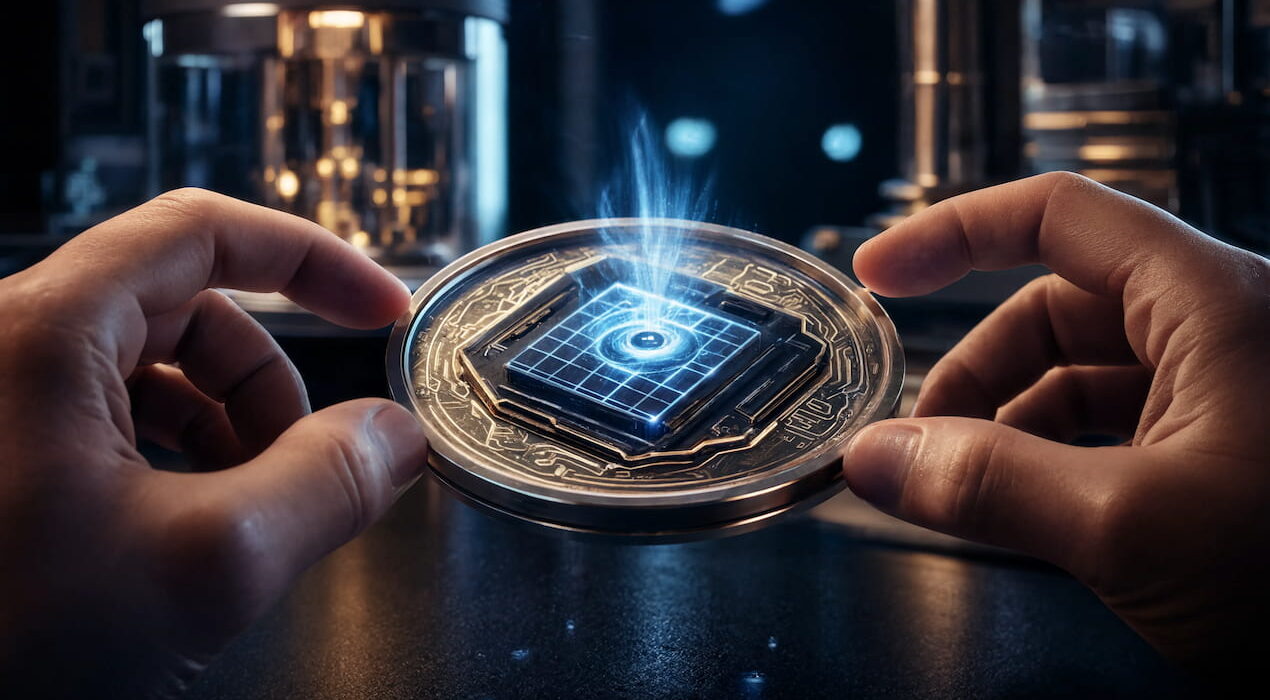
Magnon Breakthrough Unlocks Coin‑Size Quantum Computers
A recent magnon breakthrough lifts lifetimes by nearly two orders of magnitude. That opens the door to compact quantum systems that can compute on a coin‑size chip, enabling portable processing units.
Extended Lifetime Impact
Longer durations let information travel across a chip without losing coherence, preserving quantum states for periods while sustaining entanglement fidelity. Designers can link many qubits along a single pathway, creating a shared channel for entanglement and error correction. This makes error‑corrected networks far more realistic, allowing deeper circuit layers and complex algorithm execution.
Scaling Toward Practical Devices
Researchers used ultra‑pure yttrium iron garnet spheres cooled to just 30 mK, near absolute zero, to suppress thermal decay. At that temperature, lattice vibrations freeze, so decay channels shut down, dramatically extending excitation lifetimes. Impurities that once limited performance now play a minor role, no longer dictating the ultimate coherence time. With lifetimes reaching 18 µs, signals persist long enough for gate operations, enabling multi‑qubit logic cycles. Engineers can sequence pulses to perform entangling gates on many qubits, linking them through shared vibrational modes, enabling hybrid architectures. Integration with existing CMOS circuits promises low‑cost fabrication, making large‑scale deployment feasible. The advance shows that a simple material tweak can turn a fleeting ripple into a durable carrier of quantum data. That opens a realistic route to processors that fit inside a tiny coin, bringing quantum power to everyday devices. Researchers aim to integrate these thin films into flexible substrates, enabling wearable quantum devices. Such platforms could power next‑generation sensors that operate at room temperature with minimal power consumption. Continued material optimization and scalable fabrication will be essential for commercial adoption.A coin‑size quantum processor could transform medical imaging, secure communications, and complex optimization tasks. Such compact systems would open possibilities that were once confined to large laboratory installations. Future chips may even harvest ambient energy to sustain operations without external power.