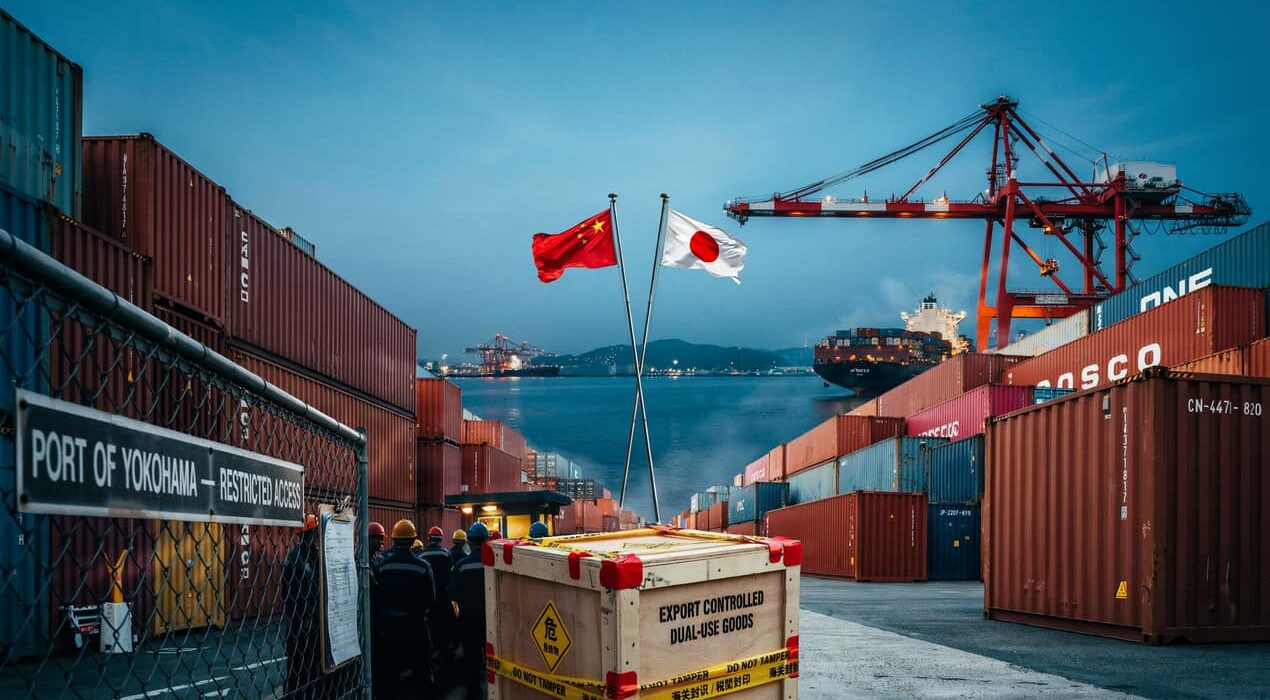
China Japan Export Curbs Escalate Tensions Over Dual-Use Trade
China has expanded its China Japan export curbs, raising tensions with Tokyo. The move targets defense linked research bodies and companies. As a result, access to critical dual-use materials may shrink. Beijing blacklisted four Japanese defense research institutes. In addition, it added 20 more entities to its export control list. These include units tied to land, naval, and air systems.
New Restrictions Hit Key Companies
The restrictions also affect major industrial players. For example, units of Mitsubishi Electric and Mitsubishi Heavy Industries now face limits. Therefore, exporters must stop shipments of Chinese dual use goods immediately. Separately, China placed another 20 firms on a watch list. These include Terra Drone Corp. and Mitsui E&S Co. As a result, stricter licensing checks now apply to their imports. Officials said exports linked to military use will not get approval. In addition, authorities will review end users more closely. This step aims to block support for Japan’s defense capabilities.
Rising Tensions and Global Impact
This move builds on earlier restrictions introduced in January. At that time, China limited exports of rare earth minerals and magnets. However, tensions kept rising after political statements from Japan. Beijing criticized Tokyo’s stance on Taiwan. Officials claimed Japan showed no regret and increased military activity. Therefore, China urged Japan to change course. Despite this, China said normal trade will continue. It also reassured law abiding firms that they face no risk.
Markets React as Risks Grow
Markets showed mixed reactions after the announcement. Some stocks fell, while others gained. This reflects uncertainty among investors. Experts say China is using its control of minerals as leverage. For example, rare earth supply chains remain heavily dependent on China. As a result, countries supporting Taiwan may face higher risks. Japan has tried to reduce this dependence since 2010. It invested in local processing and alternative sources. However, reliance on China and Vietnam still remains high. Economists warn of serious economic impact. A one year supply disruption could cut Japan’s GDP by 1.3%. That equals about $43 billion in losses.