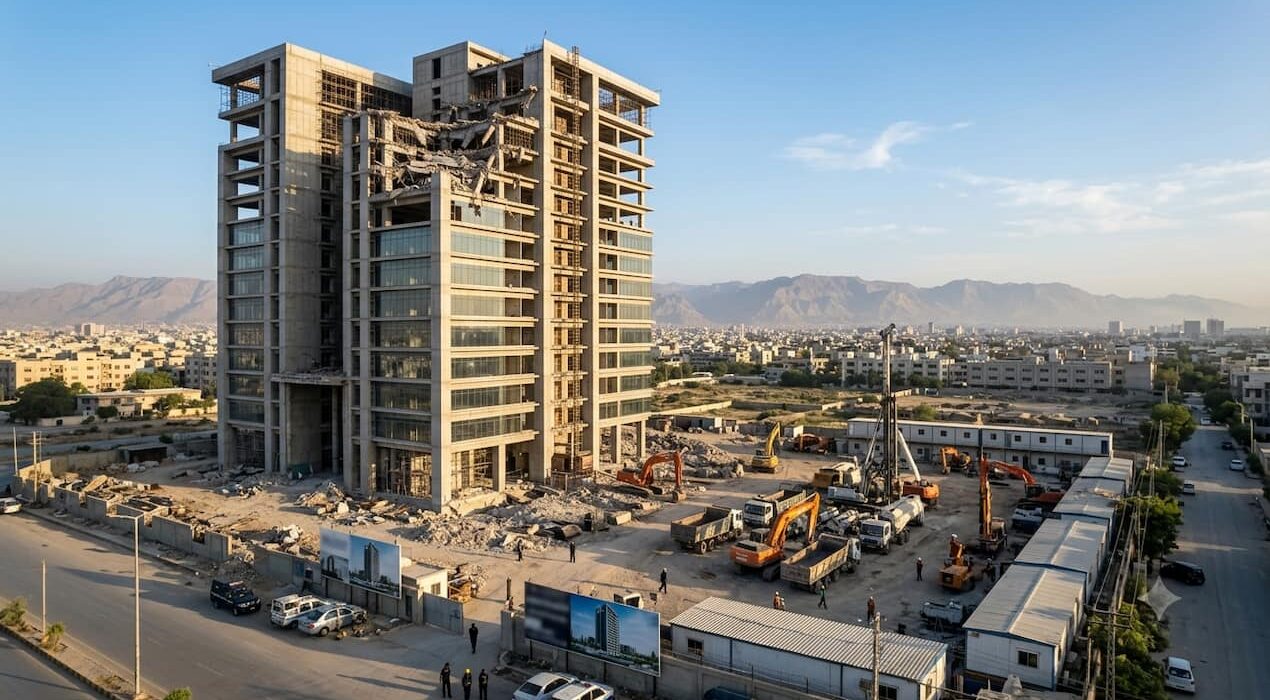
Nasla Tower Case: Constitutional Court Withdraws Supreme Court Demolition Orders
The Nasla Tower case has entered a new phase after the Federal Constitutional Court (FCC) withdrew the Supreme Court’s demolition orders issued in 2018 and 2019. The court also lifted the ban on land conversion introduced under the earlier rulings. The FCC held that the Supreme Court exceeded its constitutional jurisdiction by expanding the scope of the original appeal. However, it clarified that the decision does not protect illegal constructions. Instead, authorities must continue taking action under existing laws and constitutional procedures.
Court Assigns Responsibility to Provincial Authorities
The FCC issued its 10-page judgment, authored by Justice Aamir Farooq. The court ruled that regulating buildings and enforcing construction laws fall under the authority of the Sindh government and the Sindh Building Control Authority (SBCA). Therefore, these institutions must monitor illegal constructions and enforce the law.
The judgment explained that the original appeal involved only one illegally constructed building in Lyari. However, the Supreme Court later expanded the case to include the whole of Lyari and eventually all of Karachi. It also ordered the demolition of illegal marriage halls, shopping centres, markets and other structures. According to the FCC, these directions went beyond the issues raised in the original appeal. The court also ruled that the earlier restriction on land conversion exceeded judicial authority.
Court Stresses Due Process in Demolition Cases
The Constitutional Court ruled that authorities cannot issue demolition orders solely on the basis of SBCA reports. Instead, they must follow all legal procedures and constitutional safeguards before taking action. It also observed that the Supreme Court exercised its suo motu powers without meeting constitutional requirements.
The FCC stressed that its ruling does not legalise illegal buildings. Rather, it reinforces that existing laws already provide a clear mechanism to deal with unlawful constructions. The court formally withdrew the Supreme Court’s orders issued on December 21, 2018, and January 22, 2019. In a separate note, Justice Syed Arshad Hussain Shah urged authorities to protect parks, playgrounds, beaches, green belts and footpaths from encroachments. The ruling strengthens constitutional limits on judicial authority while placing greater responsibility on provincial institutions.