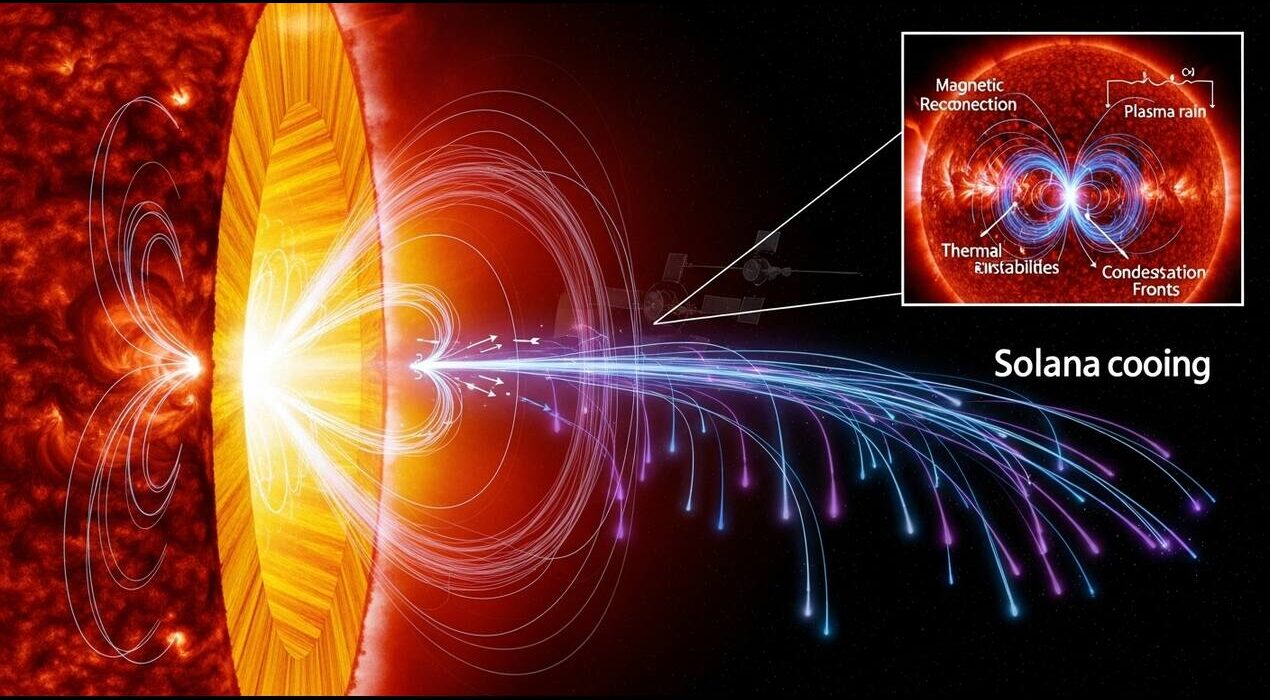
Why It Rains on the Sun- Scientists Finally Solve the Mystery
It rains on the Sun — but not the way it rains on Earth. Instead of water, the Sun’s rain is made of cooler plasma that falls back toward its surface.
Scientists at the University of Hawai‘i Institute for Astronomy (IfA) have finally discovered why this mysterious “solar rain” happens. For decades, researchers couldn’t explain how such rain formed so quickly during solar flares.
Cracking a 40-Year Mystery
Graduate student Luke Benavitz and astronomer Jeffrey Reep have found the answer. Their new study, published in the Astrophysical Journal, reveals that the Sun’s changing elemental makeup drives these plasma downpours.
“Previous models assumed elements like iron stayed constant,” said Benavitz. “But when we let those levels change, the models finally matched what we see on the Sun. The physics suddenly made sense.”
This breakthrough explains why solar rain can form in just minutes rather than hours.
Why It Matters
Understanding this process helps scientists model solar flares more accurately — and predict space weather that can affect satellites, power grids, and communication systems on Earth.
Reep added, “This discovery changes how we think about the Sun’s heating and cooling. We might need to rewrite some solar models — and that’s exciting.”
By proving that the Sun’s elements shift over time, the research opens new paths for studying how energy moves through the solar atmosphere.