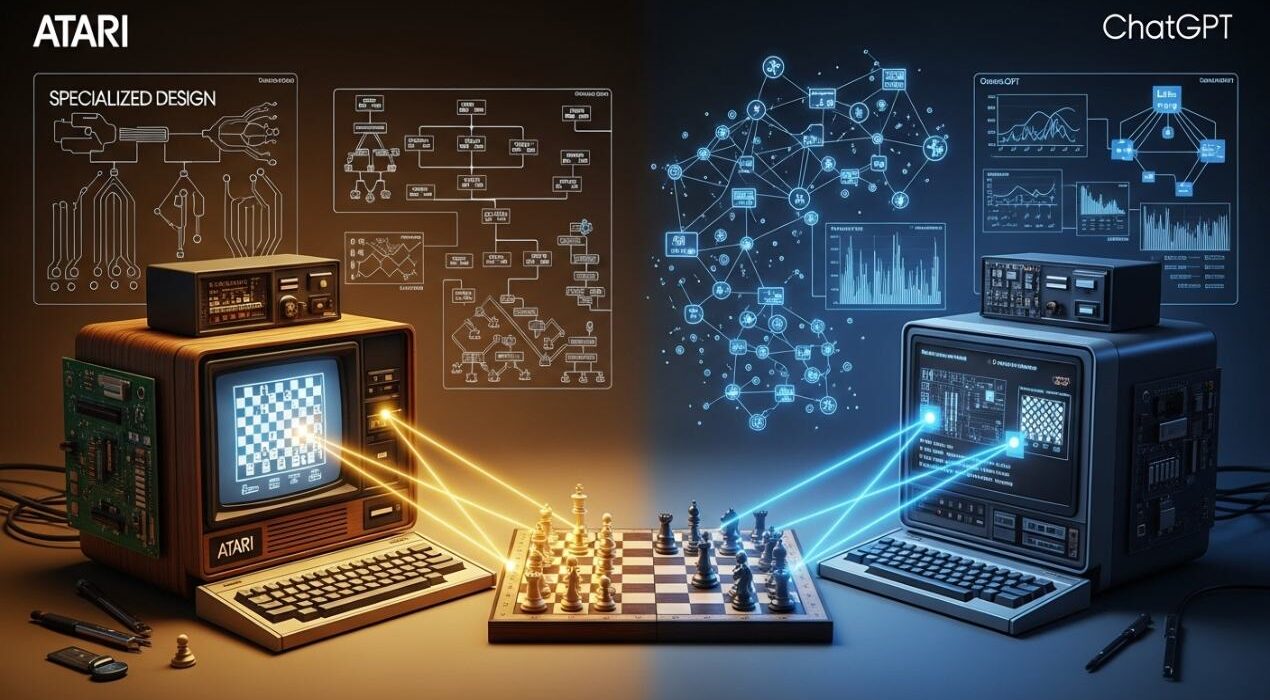
In an unexpected twist of technological history, a 1977 Atari computer has defeated OpenAI’s ChatGPT in a chess game. At first glance, this result may seem surprising, but it carries a deeper lesson: the distinction between specialized systems and general-purpose artificial intelligence.
The Atari, nearly five decades old, was built to run a dedicated chess program. Within its limited memory and processing power, it excelled at calculating legal moves, following rules, and applying simple but effective strategies. Despite being primitive compared to modern computers, the Atari was a sharp and reliable tool for its specific function—playing chess.
ChatGPT, in contrast, is not a chess engine. It is a language-based AI model trained to generate human-like text across diverse subjects. While it has absorbed patterns from thousands of chess games, it doesn’t calculate moves in the way traditional chess programs do. Instead, it predicts what the “next move” should look like based on probabilities. This approach often results in illegal moves, tactical blunders, or weak strategies when faced with a specialized opponent.
This encounter demonstrates that raw computing power and versatility do not guarantee success in every scenario. ChatGPT is an advanced model capable of writing essays, solving problems, and generating code, but when placed in a structured environment like chess, it lacks the focused logic that even older, task-specific systems possess.
The victory does not suggest that the Atari is more intelligent than ChatGPT. Instead, it reinforces a simple truth: a tool designed for a single purpose can outperform a generalist in that domain. The Atari’s success is a reminder that in technology, as in life, the right tool for the right job often proves to be the most effective.
Atari 1977 Outsmarts ChatGPT in Chess