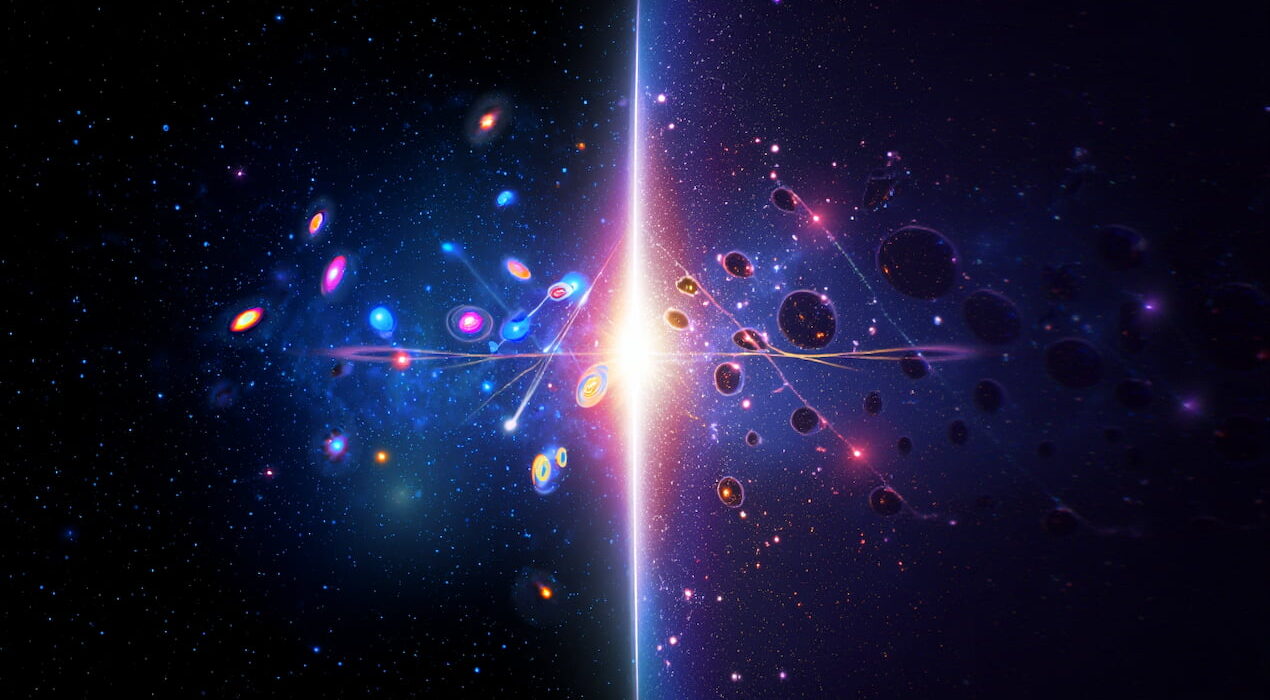
Dark Matter May Not Be One Thing, Scientists Say
Dark matter does not emit or reflect light. Yet its gravity shapes galaxies across the universe. For years, scientists assumed it was a single type of particle. New observations now challenge that idea. Some dwarf galaxies have diffuse dark matter cores. Other regions show extremely dense clumps. These two patterns seem contradictory. However, a new model may solve the puzzle.
Two Kinds of Dark Matter
Researchers propose dark matter may have multiple components. Their model includes two types of particles. One type is heavier, the other lighter. These particles interact through gravity and direct collisions. Over time, heavier particles drift inward. Lighter ones spread outward. Scientists call this “mass segregation.” It is similar to how stars behave in clusters.
Explaining the Unexpected
This two‑component model can explain both diffuse and dense dark matter. In dwarf galaxies, it produces low‑density cores. In larger systems, it creates compact clumps. Those clumps can bend light from distant galaxies. This phenomenon is called strong gravitational lensing. The model also predicts more small‑scale lensing events. That matches what astronomers actually observe.
A New View of the Universe
The findings suggest dark matter is more complex than we thought. Upcoming surveys may confirm whether it truly has multiple components. If so, our understanding of the cosmos will change. As one researcher put it, several puzzling anomalies may actually point to the same answer. Dark matter’s internal behavior could be far richer than anyone expected.