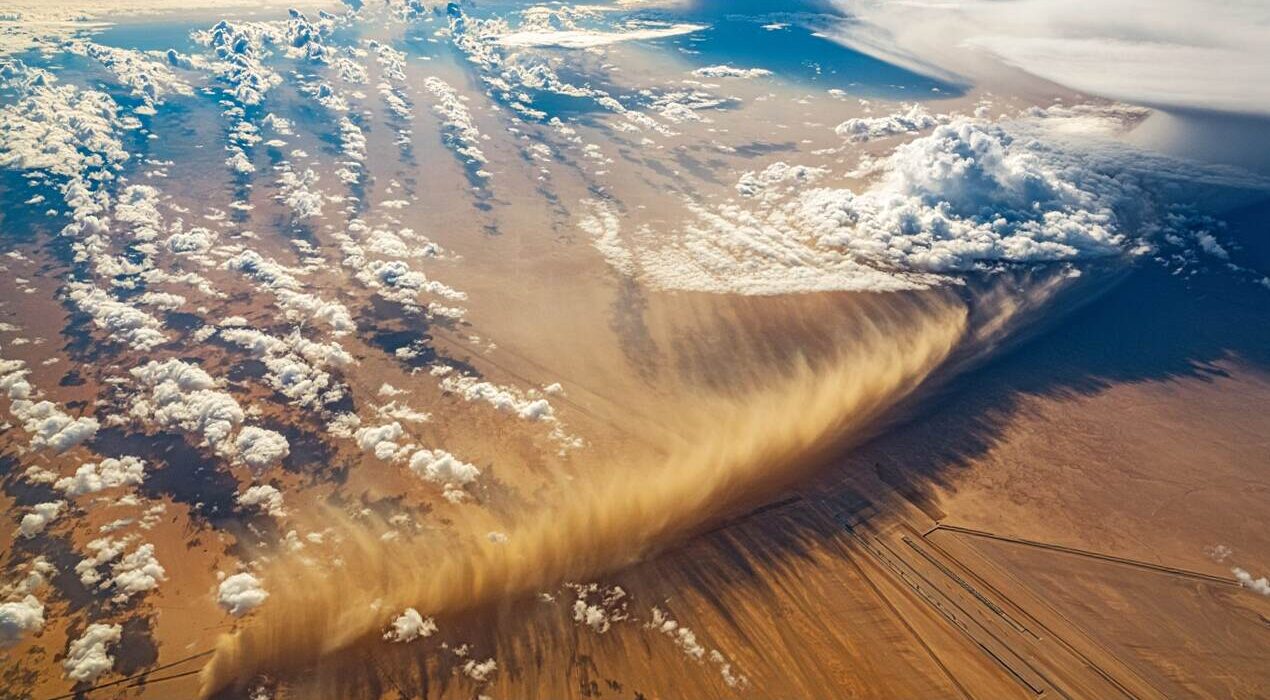
Desert Dust Is Freezing Clouds Across the Northern Hemisphere
Desert dust travels thousands of miles across the globe. It doesn’t just create hazy skies or colorful sunsets. Scientists now discover it’s actively freezing clouds. New research reveals that mineral dust from arid regions plays a major role in cloud ice formation. These tiny particles act as ice-nucleating particles, or INPs.
How Dust Changes Clouds
Clouds contain supercooled water droplets. These droplets remain liquid even below freezing temperatures. Dust particles change this completely. They provide surfaces where ice crystals can form. This process happens at warmer temperatures than normal freezing. K-feldspar and quartz are the key minerals doing this work. Both come from desert dust storms around the world.
Where the Effect Is Strongest
The impact varies by location and altitude. Dust-derived INPs dominate at high altitudes across all seasons. In the Northern Hemisphere, they constitute over 89% of the ice-nucleating particle column burden at high latitudes. The Southern Hemisphere shows about 74% at similar latitudes. K-feldspar remains the most important contributor globally. However, quartz also plays a significant role, especially at lowest and highest altitudes.
Why This Matters for Weather
When dust seeds ice formation, clouds change dramatically. Ice crystals grow differently than water droplets. This affects how clouds reflect sunlight and trap heat. Precipitation patterns also shift. Dust-laden storms show higher storm tops and broader precipitation areas. They produce heavier surface rain rates than clean systems. Saharan dust aerosols may enhance mid- and upper-level ice formation. This increases ice particle numbers and releases extra latent heat. As a result, storms become more vigorous.
The Global Dust Transport Network
Saharan dust frequently travels across the Atlantic. It reaches the Amazon rainforest, Caribbean islands, and even Europe. Asian dust storms carry particles across the Pacific. They impact weather in North America and beyond. This global transport means local cloud formation depends on distant desert conditions. A storm in Asia can affect clouds over California days later.
Understanding dust’s role helps improve climate models. Aerosol-cloud interactions remain a major uncertainty in climate predictions. Better models mean more accurate forecasts. They help predict regional precipitation changes, storm intensity, and long-term climate shifts. As deserts expand in a warming world, dust emissions may increase. This could amplify dust’s already significant impact on global cloud formation. The tiny particles crossing oceans remind us how connected our planet truly is. What happens in the desert doesn’t stay in the desert. It reaches the clouds above us all.