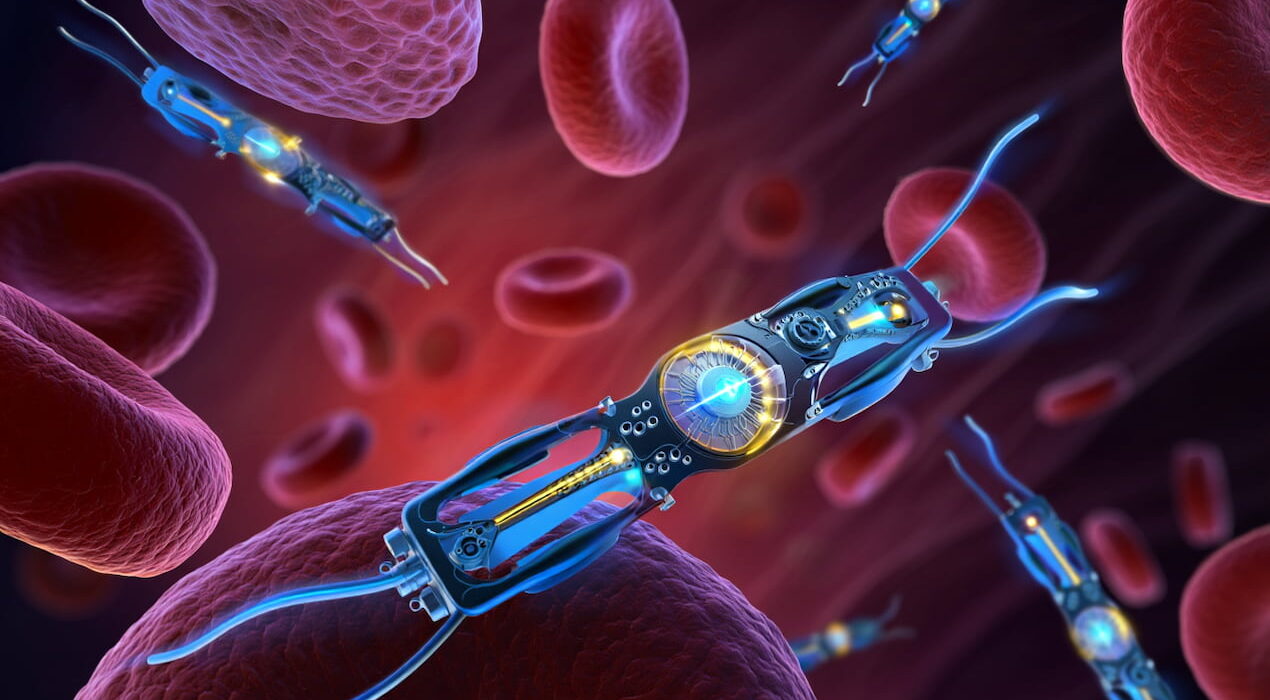
Microscopic Robots: The Tiny, Thinking Machines That Swim on Their Own
Imagine a robot smaller than a grain of salt. Now, imagine it can swim, think, and work for months. This is not science fiction. Scientists have now built the world’s smallest fully autonomous robots. Researchers from the University of Pennsylvania and the University of Michigan made this breakthrough. Each tiny robot has a microscopic computer and solar panels. They are powered by light and cost about one penny to make. Building independent robots this small was incredibly hard. In fact, scientists have struggled with this problem for forty years. Physics works very differently at such a tiny scale. “Building robots that operate independently below one millimeter is incredibly difficult,” said Professor Marc Miskin. For example, moving through water feels like pushing through tar. Traditional robot parts, like legs, are too fragile. Therefore, the team invented a completely new way to move.
A Clever Way to Swim
These robots don’t swim like fish. Instead, they use a smart trick. They create a tiny electrical field that moves charged particles in the liquid around them. This motion pulls the water, pushing the robot forward. It’s like the robot creates its own tiny current to ride. This method has no moving parts, making the robots very durable. They can be picked up with a micropipette and keep working. The real magic is the onboard computer. A team from the University of Michigan designed it. This was a huge challenge because the solar cells produce very little power. “We had to totally rethink the computer program instructions,” explained Professor David Blaauw. Their solution uses specialized, ultra-efficient circuits. As a result, the robot can sense its environment and make decisions.
Sensing and Talking Through Dance
What can these robots do? Currently, they can sense temperature very accurately. They can swim toward warmth or report readings. They communicate in a fascinating way. To share data, they perform a coded “wiggle dance.” A microscope camera watches this dance and decodes the message. It’s similar to how honeybees communicate!
A New Future for Tiny Tech
This is just the beginning. These robots are a proof-of-concept. Future versions could have more sensors or different programs. They could monitor the health of individual cells inside the body. In addition, they might help build micro-devices. This breakthrough opens a door to an entirely new world of microscopic machines. “We’ve shown you can put a brain, a sensor, and a motor into something almost too small to see,” said Miskin. “It opens the door to a whole new future for robotics.”