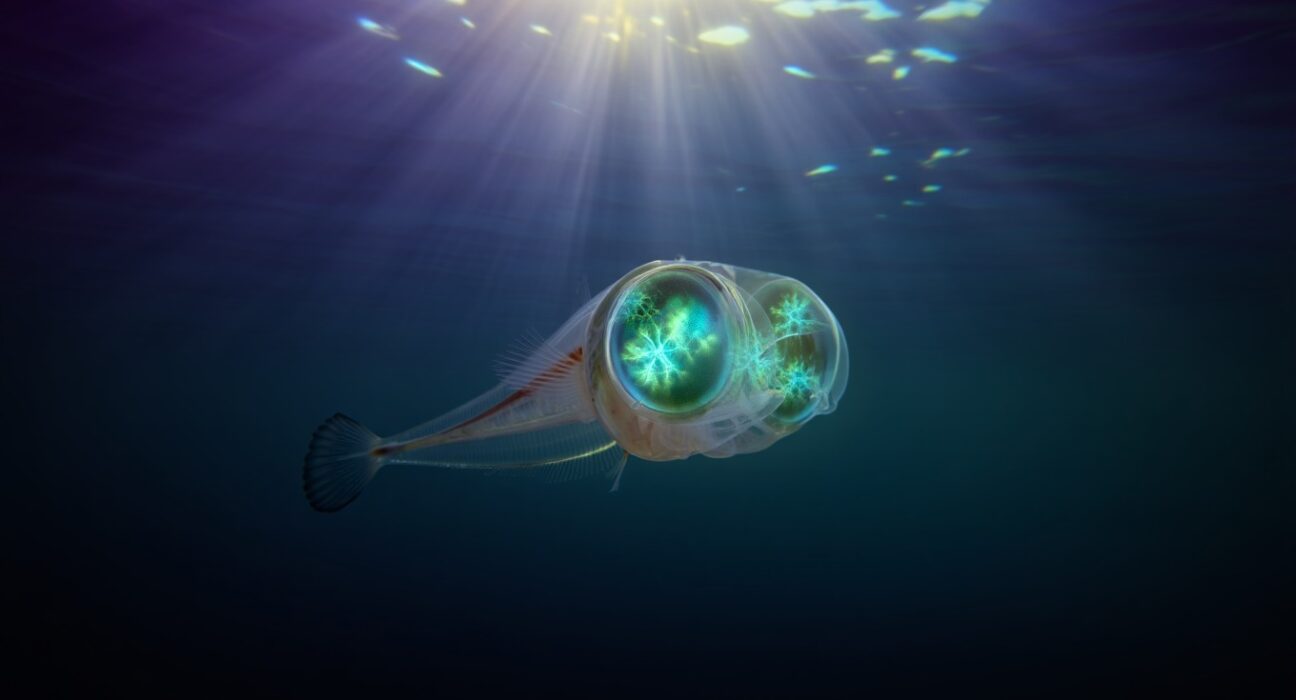
New Hybrid Eye Cell Discovered in Deep-Sea Fish Challenges Biology
Article:Scientists have discovered a new type of eye cell. It challenges what we thought we knew about vision.Deep-sea fish larvae revealed this surprise. Their eyes contain a hybrid photoreceptor. It blends features of rods and cones. For over 150 years, biology textbooks taught a simple rule. Vertebrate eyes have two main photoreceptors. Cones work in bright light. Rods work in darkness.However, this new cell does something different. It optimizes vision in twilight conditions.”This hybrid cell has the best bits of both systems,” says Dr. Fabio Cortesi from The University of Queensland. “It combines cone molecular machinery with rod shape and form. Therefore, it works really efficiently for twilight vision.”
Why Twilight Vision Mbatters
Sunlight fades fast in the ocean’s “twilight zone.” Colors disappear quickly. Shadows soften and blend together. Even small improvements in sensitivity matter greatly. They can mean the difference between finding food and going hungry.Many deep-sea fish don’t start life in the deep ocean. They feed and grow near the surface first. As they mature, they migrate downward. This exposes them to changing light conditions. As a result, their vision must keep up with their environment.”We wanted to investigate how their early vision develops,” explains Dr. Lily Fogg, a researcher on the team. “They live in half-light near the surface. Later, they descend into one of the dimmest habitats on Earth.”
Studying Tiny Eyes
The research team examined larval retinas from the Red Sea. They collected samples between 20 and 200 meters deep. This required several marine exploration voyages.The work proved extremely challenging. “The larvae are only half a centimeter long,” Dr. Fogg notes. “Their eyes are smaller than a millimeter.”Despite these difficulties, the team succeeded. They identified the hybrid cells in two pearlside species. Both larvae and adults have these unique photoreceptors.This discovery could lead to practical innovations. Nature often solves problems that engineers still struggle with. Low-light vision is one such challenge.”In technology, we could create better sensors,” Dr. Cortesi explains. “Cameras or goggles for low-light situations could become more efficient. They wouldn’t sacrifice image sharpness.”In medicine, the finding also holds promise. “Learning how these fish build visual cells in deep oceans matters,” he adds. “It could unlock biological pathways relevant to human eye conditions. Glaucoma research might benefit, for example.”Low-light imaging challenges many fields. Underwater exploration depends on it. Emergency response teams need it. Night-time navigation requires it. Therefore, this tiny fish eye could inspire big advances. The discovery proves that even basic biology still holds surprises. After 150 years of vision research, nature continues to amaze us.