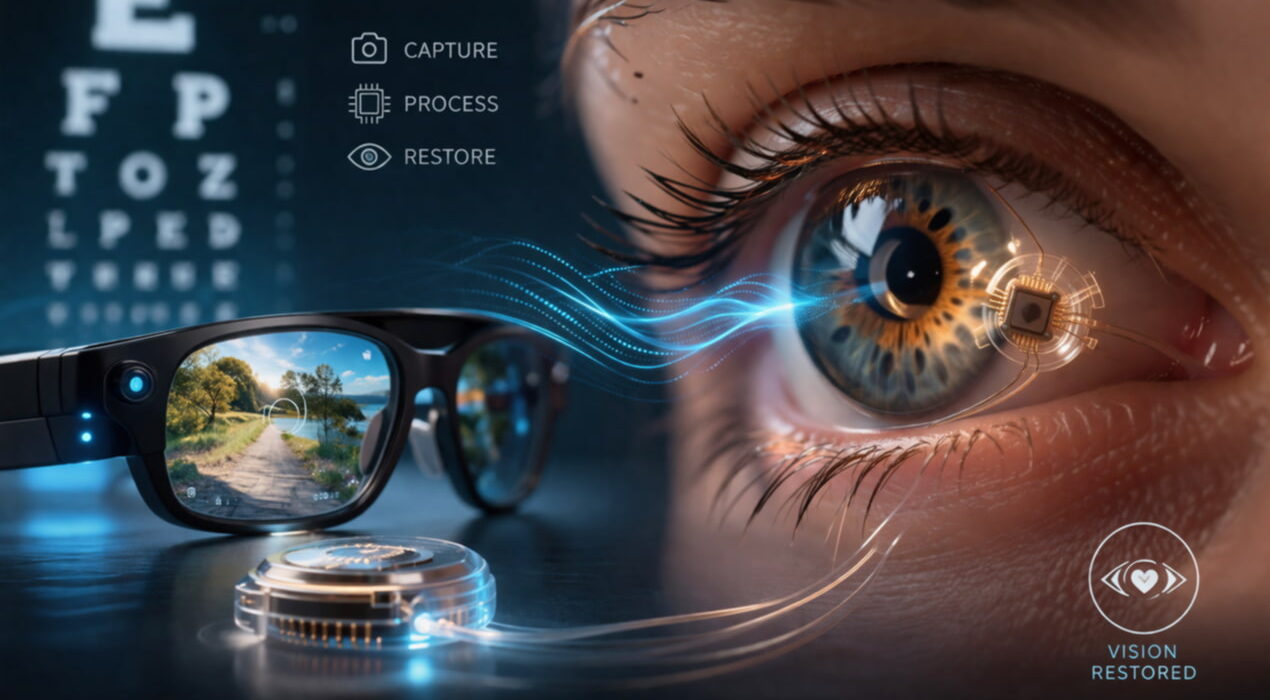
Restore Vision Technology: Smart Glasses Bring New Hope
Losing central vision can turn simple tasks into daily challenges. With restore vision technology, people may regain some independence. Reading menus, recognizing faces, or checking medicine labels often becomes difficult. As a result, many people struggle with everyday activities once their central sight fades.
For those with advanced dry age-related macular degeneration, this loss feels permanent. In particular, geographic atrophy damages the central retina over time. Therefore, most patients rely on coping strategies instead of recovery. However, new research is starting to change that outlook.
How the New System Works
Scientists have developed a retinal prosthesis called PRIMA. It combines a tiny implant under the retina with smart glasses. First, the glasses capture images from the environment. Then, digital processing converts these images into signals.
These signals travel to the implant placed in the eye. The implant stimulates remaining retinal cells. As a result, the brain begins to interpret visual patterns again. Over time, users may learn to recognize shapes and letters.
What the Study Found
A recent clinical study showed encouraging results. Many participants regained some central visual function. For example, they could identify letters, words, and basic shapes again. This improvement helps with reading and navigation.
In addition, patients reported better confidence in daily life. However, results can vary from person to person. The system does not restore vision fully. Still, it offers meaningful improvement for many users.
Why It Matters for Patients
This breakthrough highlights the potential of restoring vision technology. It gives new hope to people living with severe vision loss. Moreover, it shifts the focus from adaptation to partial recovery.
Researchers continue to refine the system for better accuracy. Therefore, future versions may offer even stronger results. While it is not a complete cure, this innovation marks a major step forward in eye care.