Santorini Earthquakes: Magma Surge Caused 28,000 Tremors
In early 2025, the Greek island of Santorini would not stop shaking. More than 28,000 earthquakes rattled the region over several weeks. Residents grew worried. Scientists scrambled for answers. Now, a new study published in Nature reveals what happened underground. The culprit was not just shifting tectonic plates. It was something far more powerful: rising magma.
What Actually Happened Under Santorini
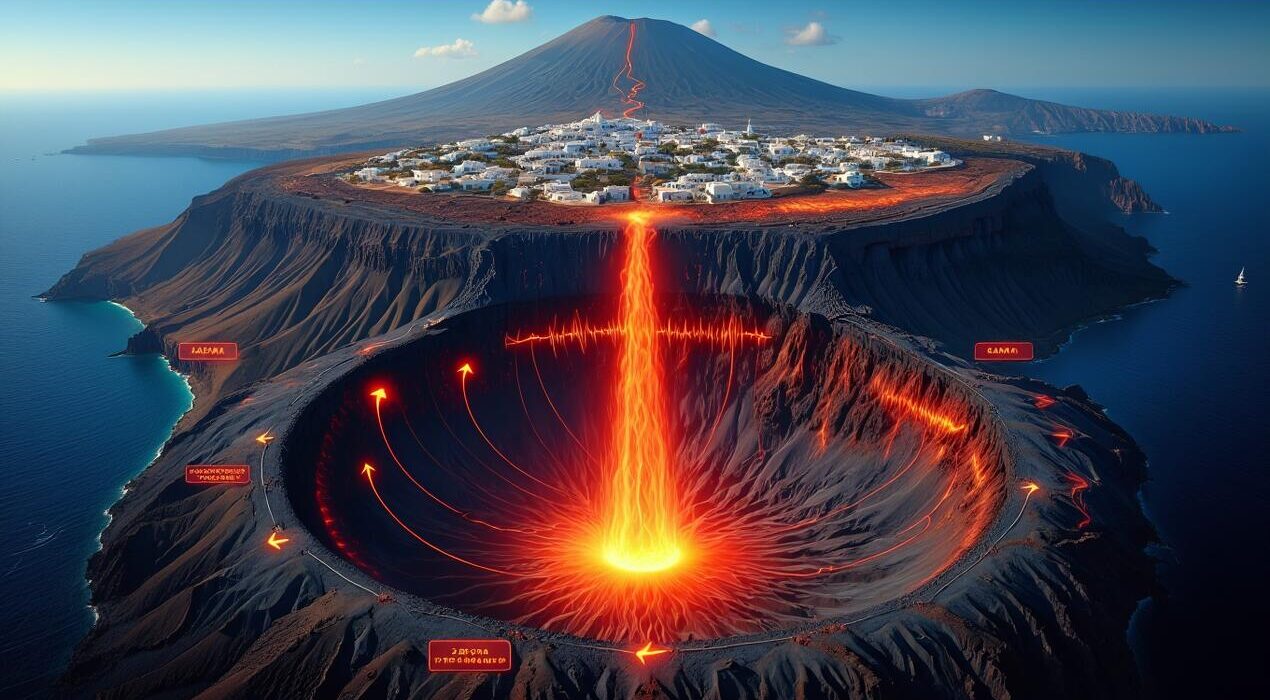
Researchers from GFZ and GEOMAR led the investigation. They combined data from land sensors and seafloor instruments. They also used artificial intelligence to map earthquake locations with incredible precision. The findings are striking. About 300 million cubic meters of magma pushed upward through the crust. This molten rock rose from deep below and stalled roughly four kilometers under the seafloor. As the magma moved, it fractured surrounding rock. This breaking process triggered thousands of earthquakes. In fact, the seismic activity migrated over time. It shifted more than 10 kilometers northeast of Santorini.
A Region Built for Volcanic Activity
Santorini sits in one of Europe’s most active geological zones. The Hellenic volcanic arc stretches across the eastern Mediterranean. The African Plate pushes against the Hellenic Plate here. This pressure creates fault lines and melting rock. Santorini itself formed from a massive eruption 3,600 years ago. Nearby Kolumbo is an active underwater volcano. The region has a history of violent events. In 1956, two massive earthquakes struck between Santorini and Amorgos. They generated a tsunami. Therefore, the 2025 swarm raised immediate concerns.
How Magma Drove the Earthquake Swarm
The process actually began months earlier. In July 2024, magma accumulated beneath Santorini. The island lifted slightly as a result. Seismic activity increased in January 2025. Then magma started rising from deeper levels. Earthquake depths shifted upward in pulses. They moved from 18 kilometers deep to just three kilometers below the seafloor.
As magma shifted, Santorini gradually sank back down. Scientists interpret this as evidence of a hydraulic connection. Santorini and Kolumbo appear linked underground. Dr. Jens Karstens from GEOMAR notes: “We could follow the crisis in near real time. We even learned about interaction between the two volcanoes.”
Technology Revealed the Hidden Activity
Two innovations made this discovery possible. First, GFZ scientists used AI to analyze massive seismic datasets. Second, GEOMAR had already deployed instruments at Kolumbo’s crater. These seafloor sensors recorded earthquakes and pressure changes. They detected the seabed sinking up to 30 centimeters during magma intrusion.