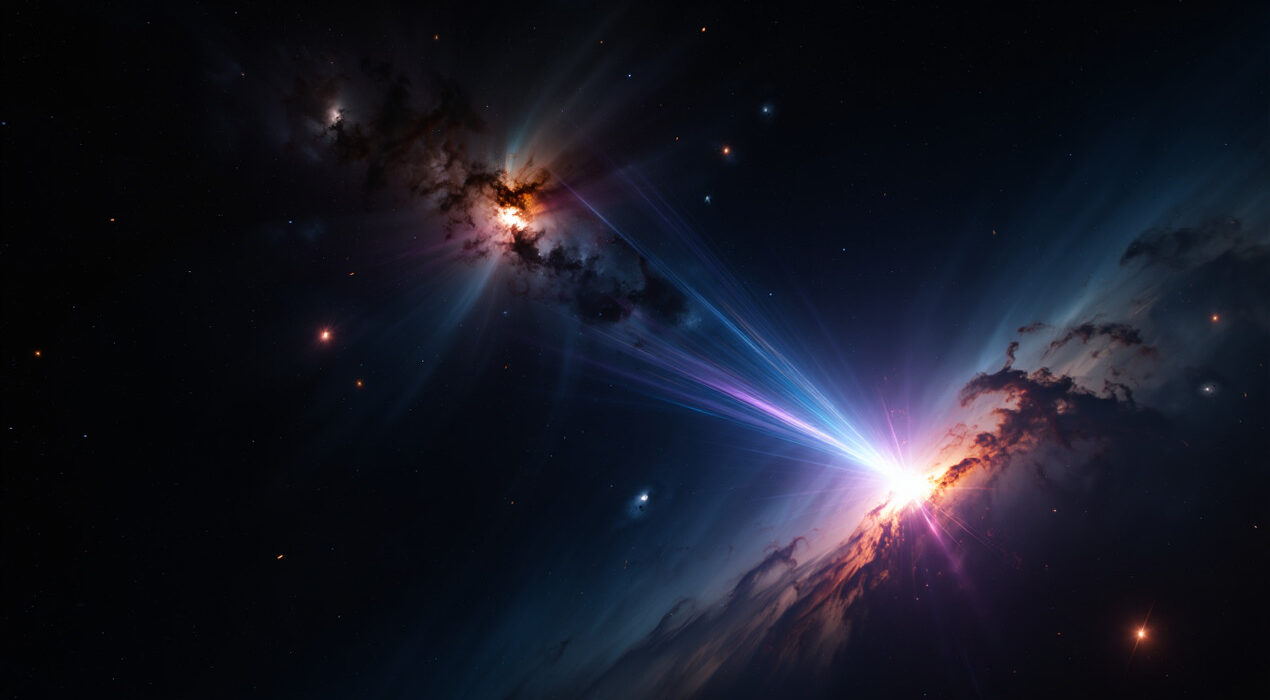
Seven-Hour Gamma-Ray Burst Challenges Everything Astronomers Know
Astronomers have recorded a cosmic explosion unlike any seen before. The event lasted nearly seven hours, setting a new duration record. As a result, scientists are questioning long-standing ideas about gamma-ray bursts. The burst, known as GRB 250702B, was first detected in July 2025. It remained active far longer than typical events. Therefore, researchers consider it a major scientific mystery.
Why Gamma-Ray Bursts Matter
Gamma-ray bursts are powerful flashes of high-energy radiation. They usually occur during violent cosmic events, such as stellar collapse. Most gamma-ray bursts last only seconds or minutes. However, GRB 250702B continued for hours, which current models cannot fully explain.
Scientists Tracked the Explosion
Space-based instruments detected the burst first. Soon after, ground-based telescopes around the world began monitoring its fading light. Astronomers traced the source to a distant galaxy filled with dense cosmic dust. In addition, the dust blocked most visible light, limiting traditional observations. Because of this, scientists relied on infrared and high-energy data. Teams combined observations from NASA, European observatories, and major U.S. telescopes.
Possible Causes Remain Uncertain
Researchers have not confirmed what caused the explosion. Several explanations remain under active discussion. For example, a massive star may have collapsed in an unusual way. Another possibility involves the merger of rare stellar objects. Some evidence also suggests a black hole may have torn a star apart. However, available data cannot yet confirm any single theory. This rare event allows scientists to study extreme cosmic environments. It also helps explain how matter behaves near the speed of light.Gamma-ray bursts spread heavy elements across the universe. These elements later contribute to planets and life. In the future, GRB 250702B will serve as a key reference point. Scientists will compare similar events against this discovery.