Astronomers See Spinning Black Hole Twist Spacetime, Proving Einstein Right
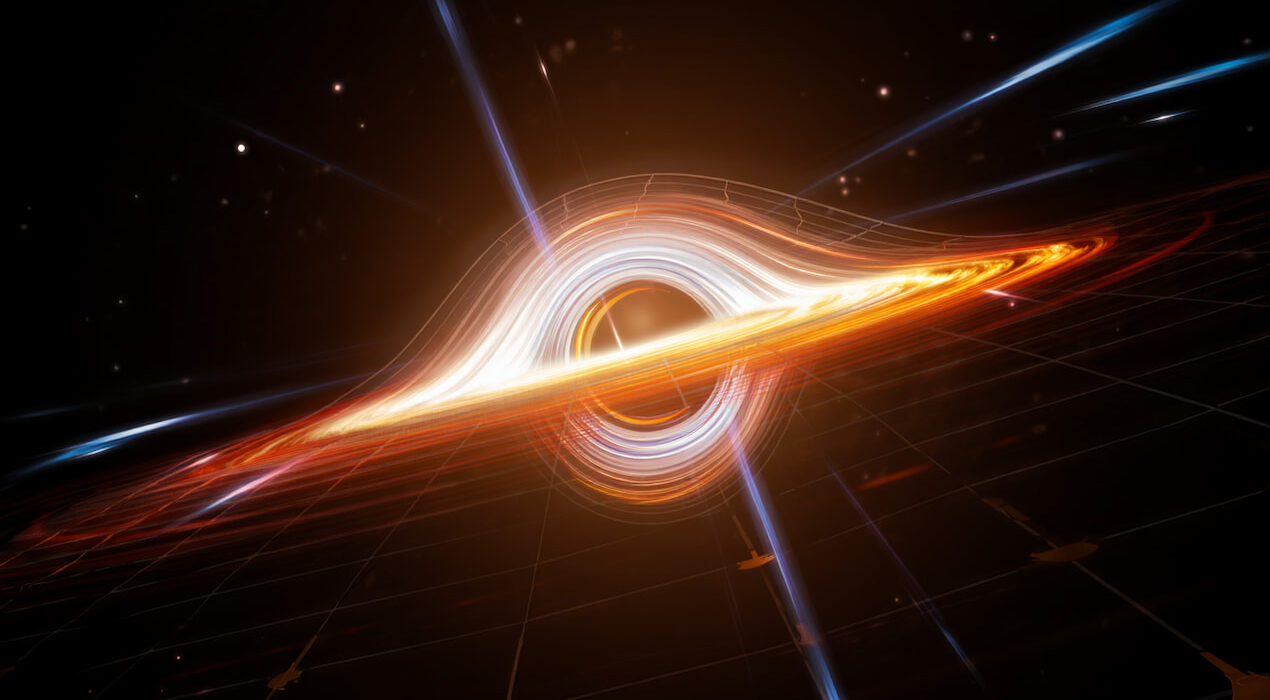
Astronomers have observed spacetime wobbling near a spinning black hole. This rare sight confirms a prediction Einstein made over a century ago. As a result, scientists gain fresh insight into extreme cosmic physics. The discovery came during a dramatic stellar destruction. A star strayed too close and was torn apart. Its death revealed the hidden motion of spacetime itself. The effect is called Lense Thirring precession. It happens when a rotating black hole twists spacetime around it. Nearby matter then follows a slow, wobbling path. Although predicted long ago, the effect is hard to detect. It requires precise timing and rare cosmic events. Therefore, scientists searched for years.
A Star’s Destruction Reveals the Clue
Researchers studied an event called AT2020afhd. In this case, a star was shredded by a supermassive black hole. The debris formed a bright, spinning disk. At the same time, powerful jets shot outward at near light speed. Scientists tracked X-ray and radio signals carefully. They noticed a repeating wobble every 20 days. Both the disk and jets moved together in rhythm. This shared motion matched predictions of frame dragging. Therefore, the signal provided direct evidence of twisted spacetime. The idea dates back to Einstein’s early work. Later, physicists Lense and Thirring refined it mathematically. Now, observations finally confirm it.
How Telescopes Made It Possible
The team used space and ground-based telescopes. These included the Swift Observatory and the Very Large Array. In addition, spectroscopy revealed details of the surrounding matter. Together, the data ruled out simpler explanations. The wobble came from spacetime itself. As a result, scientists gained a new tool to study black holes. This finding improves our understanding of black hole spin. It also explains how matter falls inward and jets form. Ultimately, it opens new paths for exploring the universe.