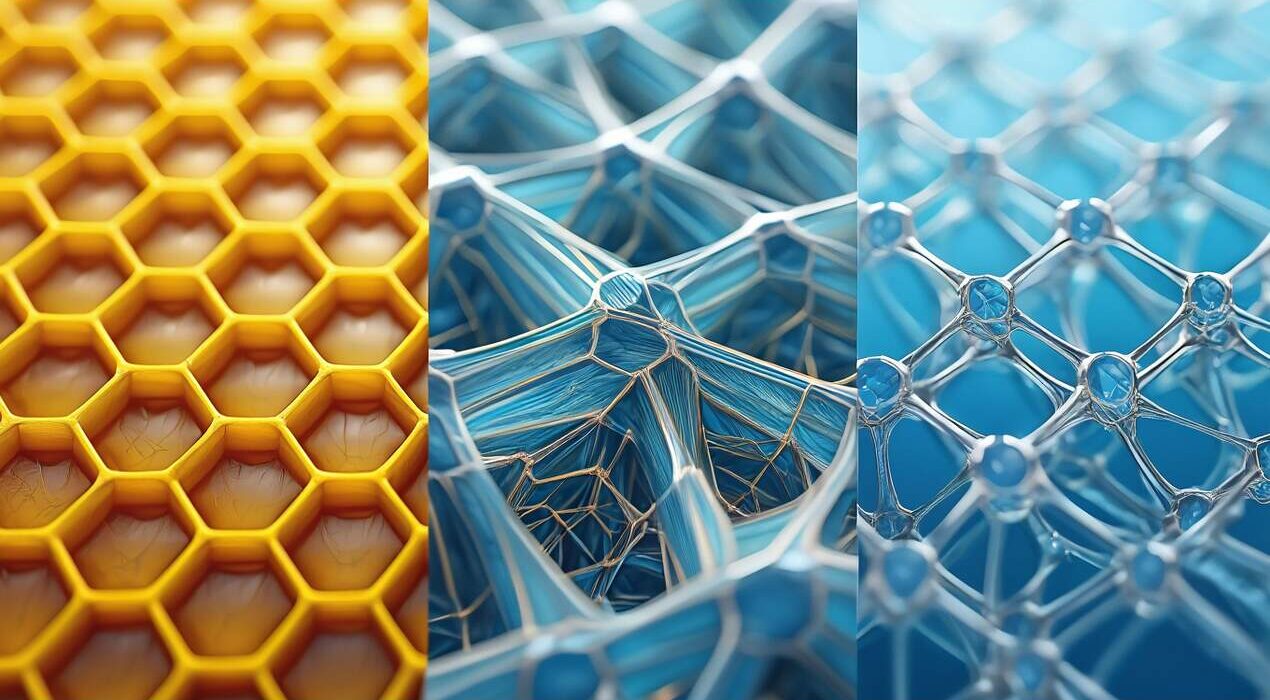
Why Tessellations Are More Than Art, According to Mathematicians
Tessellations often catch the eye with repeating shapes and perfect balance. However, mathematicians say these patterns do much more than decorate surfaces. New research shows that tessellations help solve complex mathematical problems. Researchers at Freie Universität Berlin studied planar tiling in depth. They found that repeating geometric patterns support advanced mathematical analysis. Their work appeared in the journal Applicable Analysis.
The Mathematics Behind Repeating Patterns
Tessellations cover surfaces using shapes without gaps or overlaps. Artists have used them for centuries. However, mathematicians now apply them as analytical tools.The study introduces the parqueting-reflection principle. This method reflects shapes across edges to fill an entire plane. As a result, the process creates strong symmetry and structure.
Many people recognize tessellations from M.C. Escher’s artwork. However, the researchers showed deeper value behind these designs. The reflection principle helps solve boundary value problems.These problems include Dirichlet and Neumann equations. Scientists often face them in physics and engineering. Therefore, tessellations bridge beauty and practical problem solving.
Unlocking Powerful Mathematical Tools
The researchers used tessellations to derive precise formulas. These include Green, Neumann, and Schwarz kernel functions. Such tools play a key role in physical modeling.In addition, the method works beyond flat geometry. It also applies to hyperbolic spaces. These spaces appear in theoretical physics and space-time studies.Interest in the parqueting-reflection principle continues to grow. Over the past decade, many students have explored it in academic research. Scientists worldwide now use the approach.Researchers hope the findings inspire other fields. Architecture and computer graphics may benefit from these patterns. Ultimately, the study shows mathematics as both visual and powerful.