Scientists Create Living Blood Vessel Chip to Transform Disease Research | Texas A&M
For years, scientists studied blood vessels as straight tubes. But human vessels are much more complex. They twist, branch, narrow, and bulge. These shapes directly affect how blood flows. They also influence where diseases like aneurysms and blockages start. Researchers at Texas A&M University wanted to change the old model. So they built something better.
A Living Chip That Mimics Real Vessels
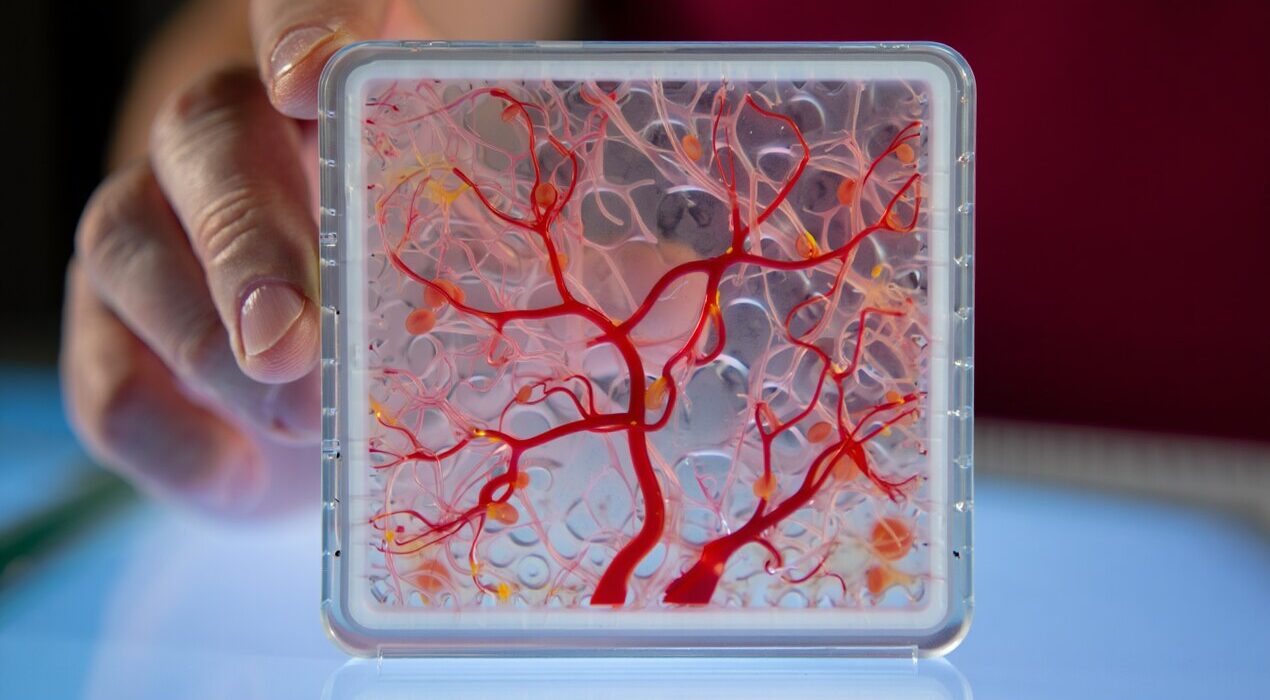
The team created a “vessel-chip” that looks and acts like real blood vessels. It is a small device with living cells inside. Scientists can shape it to match different vessel conditions. For example, they can model a widened aneurysm or a narrowed stenosis. This lets them see how blood flow changes in each case. It also shows how vessel walls respond to stress. Jennifer Lee, a biomedical engineering master’s student, led the design work. She built on earlier straight-vessel models from the same lab. Her research will soon appear on the cover of Lab on a Chip.
Why This Matters for Medicine
This chip offers a powerful new way to study disease. Researchers can now watch vascular problems develop in real time. They can also test drugs without using animals. Dr. Abhishek Jain, who leads the lab, explained the impact. “We can now learn about vascular disease in ways we never could before,” he said. “These complex shapes are where diseases start. Understanding them is critical.”
More Than Science Skills
The current model includes endothelial cells, which line blood vessels. But future versions will add more cell types. This will help scientists study how tissues interact with blood and each other. Jain calls this the “fourth dimension” of organs-on-a-chip. It combines complex structure, living cells, and blood flow in one system
Lee said the lab taught her more than research. She learned teamwork, communication, and how to try new ideas. “It’s such a good environment,” she said. “Students have access to amazing faculty labs. That experience is invaluable. “Major organizations funded this work, including NASA, the FDA, and the U.S. Army.