Neanderthals and Hunter-Gatherers Shaped Europe’s Wilderness
Neanderthals and early hunter-gatherers reshaped forests and grasslands. They used fire and hunted giant animals. This happened tens of thousands of years before agriculture arrived. Scientists now say prehistoric humans engineered their environment. The effects were measurable and lasting.
An international team led by Aarhus University ran advanced computer simulations. They studied two warm periods in Europe’s past. First was the Last Interglacial, 125,000 years ago. Neanderthals lived there alone. Second was the Early Holocene, 12,000 years ago. Mesolithic hunter-gatherers our own species inhabited the land. Researchers compared simulations with fossil pollen data. Pollen preserves evidence of ancient plants. The match was clear.
What Did Early Humans Do?
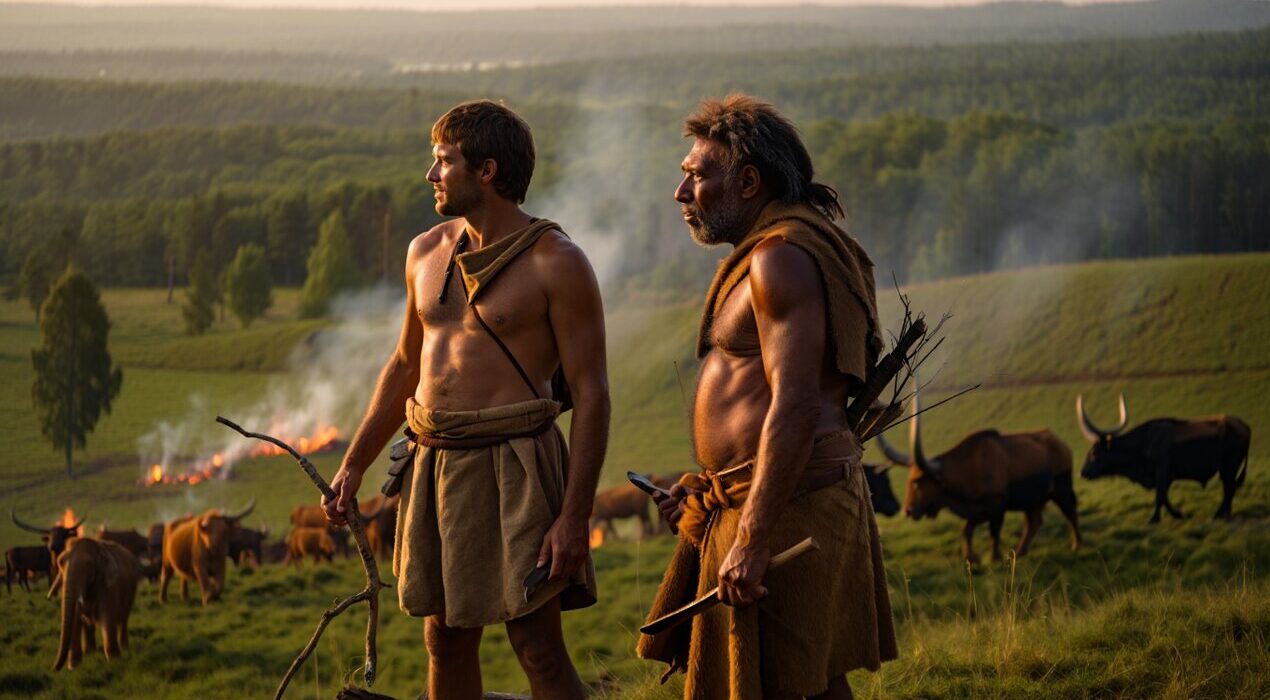
They did two main things. First, they set fires. Fire cleared trees and shrubs. This opened up forests. Second, they hunted megafauna. We are talking elephants, rhinos, bison, and aurochs. Neanderthals killed animals weighing up to 13 tonnes. Fewer large herbivores meant less grazing. As a result, vegetation grew denser. More shrubs and trees took over.
How Big Was the Impact?
Mesolithic hunter-gatherers influenced up to 47% of plant distribution. Neanderthals shaped about 6% of plant types and 14% of vegetation openness. Their impact was smaller but still real. However, Neanderthals never wiped out megafauna completely. Later humans did. For years, people believed Europe was pristine before farming. This study shatters that idea. “Neanderthals and Mesolithic hunter-gatherers were active co-creators of Europe’s ecosystems,” said Professor Jens-Christian Svenning. Hunting alone changed landscapes. Even without fire, reducing animal populations made vegetation shift.
How Did They Prove It? The team used AI-powered simulations. They ran thousands of scenarios. An optimization algorithm identified the most likely outcomes. This is the first study to quantify prehistoric human impact across an entire continent. “We brought together ecology, archaeology, and pollen science,” said researcher Anastasia Nikulina. Scientists want to apply this method to other regions. The Americas and Australia are prime candidates. Those lands had no hominins before Homo sapiens. Local studies also matter. Large models give broad pictures. Small sites reveal finer details. “Our study shows you cannot understand ancient nature without understanding ancient humans,” Svenning said.