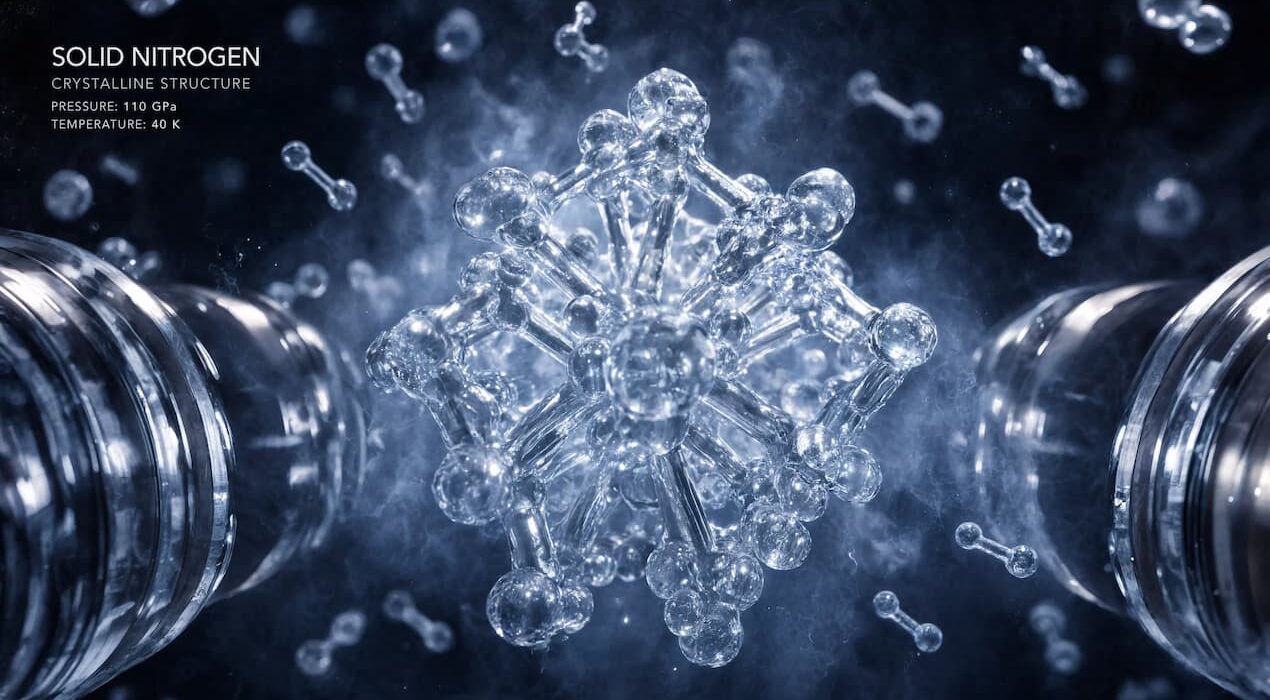
Solid Nitrogen Mystery Solved After 50 Years
Scientists have finally solved the solid nitrogen mystery that puzzled researchers for over five decades. The breakthrough reveals the hidden structure of a rare form of solid nitrogen. This discovery could improve our understanding of materials under extreme conditions. Nitrogen fills most of Earth’s atmosphere. However, high pressure and very low temperatures change its behavior completely. Under those conditions, nitrogen forms unusual solid structures that scientists have struggled to explain.
Advanced Tools Reveal the Hidden Structure
An international research team combined several advanced techniques to study γ-N₂. They used synchrotron X-ray diffraction, Raman spectroscopy, infrared spectroscopy, and computer simulations. Together, these methods produced clear and reliable results. The researchers confirmed that γ-N₂ has a monoclinic P2₁/c crystal structure. This finding supports a prediction scientists proposed many years ago. It also explains why earlier studies produced conflicting conclusions. Growing high-quality crystals of γ-N₂ has always been difficult. Therefore, researchers often worked with poor-quality powder samples. The new approach overcame this challenge by comparing multiple sources of evidence. Scientists also solved another puzzling observation. An unusual vibration came from nitrogen-15, a rare isotope, instead of a different crystal structure. As pressure increased, the signals interacted through a process called Fermi-like resonance.
Why the Discovery Matters
The team also found strong similarities between γ-N₂ and another solid form called θ-N₂. Although both phases develop under different conditions, they share related molecular arrangements. This discovery provides a clearer picture of how nitrogen behaves under extreme environments. As a result, scientists can build more accurate models of matter at high pressures. Future research may uncover new materials with unique physical properties. These findings could support advances in physics, materials science, and high-pressure research.