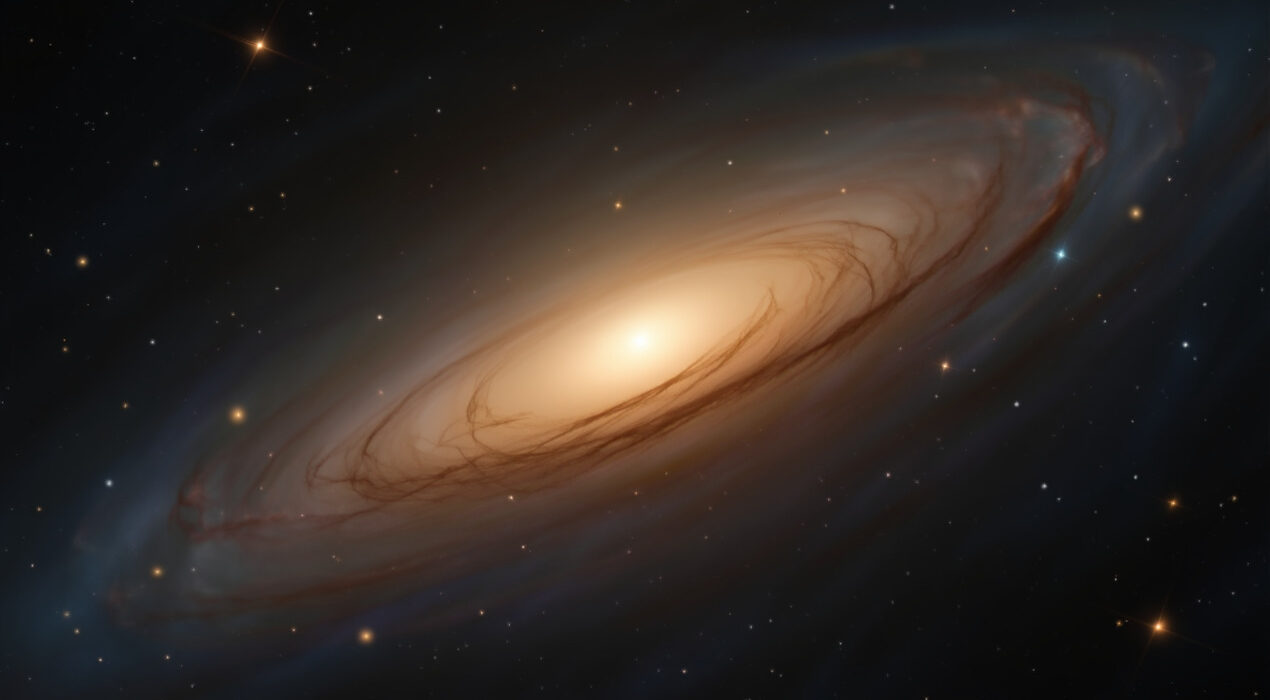
Ancient Galaxy No Spin Baffles Astronomers
Astronomers found an ancient galaxy with no spin. This object lived less than 2 billion years after the Big Bang. Usually, young galaxies rotate. However, this one does not. The James Webb Space Telescope spotted the strange find. Its official name is XMM-VID1-2075. Scientists call it a “slow rotator.” That term normally applies to old systems.
This Discovery Matters
Lead author Ben Forrest is from UC Davis. He says non-rotating galaxies are rare. They usually appear only after billions of collisions. Therefore, finding one so early is shocking.
Forrest notes this system is huge. It holds several times more stars than our Milky Way. In addition, it has stopped making new stars. That makes it a good research target.How did this ancient object lose its spin? One explanation involves a massive crash. Another galaxy may have hit it from the opposite direction. The collision could have canceled the rotation. As a result, stars now move in random pathsWebb’s data supports this idea. The telescope saw light off to one side. That suggests another object is interacting. For example, a recent merger could change a system’s dynamics.Before Webb, the team used the Keck Observatory. Those observations confirmed the object was enormous. They showed it was no longer forming stars. That made it a great candidate for follow-up work.The researchers studied two other ancient objects from the same era. One showed clear rotation. Another looked irregular. Only XMM-VID1-2075 had random motion without spin.“This was surprising,” Forrest explains. “We did not expect to see this so early.”
The team will search for more non-rotating systems. They can compare real data with computer simulations. Those simulations predict very few such cases in the early universe. Therefore, each new find tests our theories. Understanding these strange objects will tell us if our models are correct. It may rewrite the story of cosmic evolution.