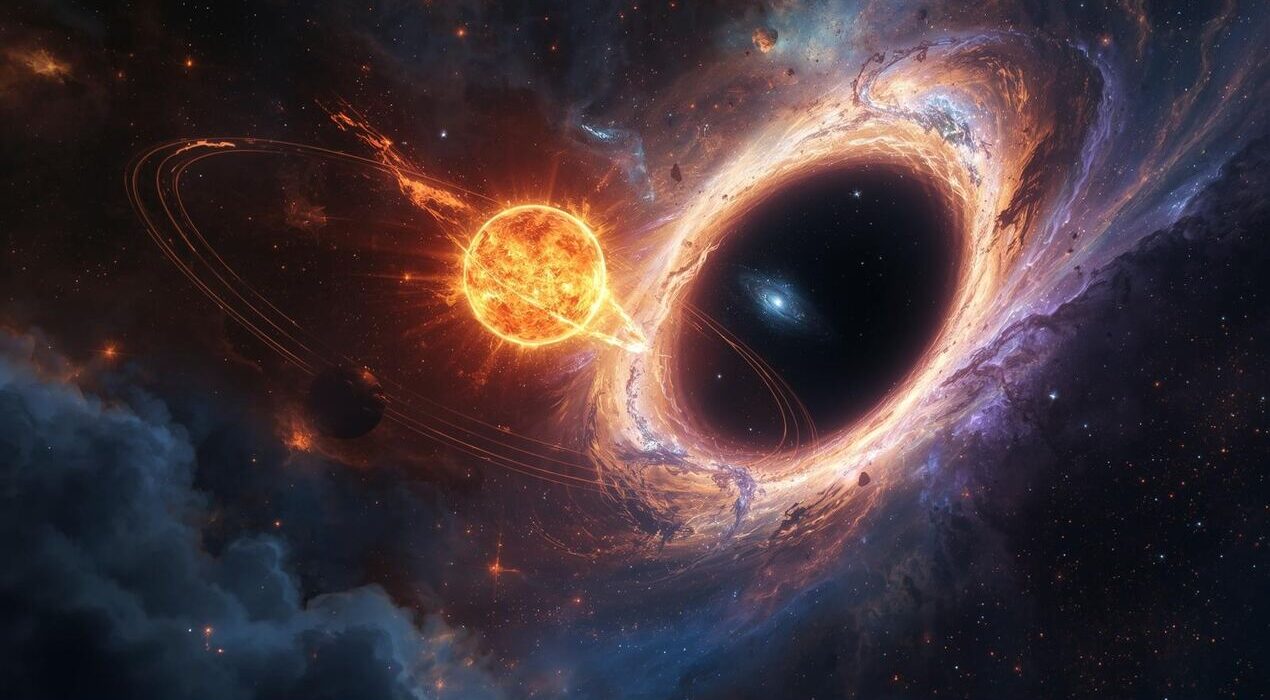
Astronomers Find a Rule-Breaking Star Orbiting a Silent Black Hole
Astronomers in Hawaiʻi have uncovered the surprising history of a distant red giant. They noticed tiny vibrations in its light, which hinted at a long-ago collision. As a result, the star now spins far faster than expected.This unusual star belongs to the Gaia BH2 system. It also orbits a silent black hole that shows no signs of feeding.
Hidden Vibrations Tell a Story
Researchers used NASA’s TESS spacecraft to study the star’s faint “starquakes.” These ripples moved through the star like sound waves. In addition, they revealed details about its inner structure with remarkable accuracy.The European Space Agency’s Gaia mission first identified this system as a black hole pair in 2023. The new data offered fresh insight into the companion star. According to lead author Daniel Hey, these vibrations work much like earthquakes do for Earth. They help scientists look deep inside a star.
Young, Yet Full of Ancient Elements
The team found something even stranger. The star is “alpha-rich,” meaning it contains heavy elements usually found in very old stars. However, the vibrations show that it is only about five billion years old.This rare mix suggests that the star gained mass from another object. Therefore, it likely merged with a companion or absorbed material during the black hole’s formation.
A Spin That Breaks the Rules
Ground-based telescopes added another twist. They showed the star rotates every 398 days, which is fast for a red giant of its age. The team believes tidal interactions in the system spun it up over time.
Looking Ahead
Astronomers also studied Gaia BH3, another puzzling black hole system. Its companion star showed no vibrations, challenging current models. Future TESS observations may uncover more clues about how these quiet black hole systems formed.