Cambridge Team Powers “Impossible” Nanoparticles to Create Ultra-Pure LED
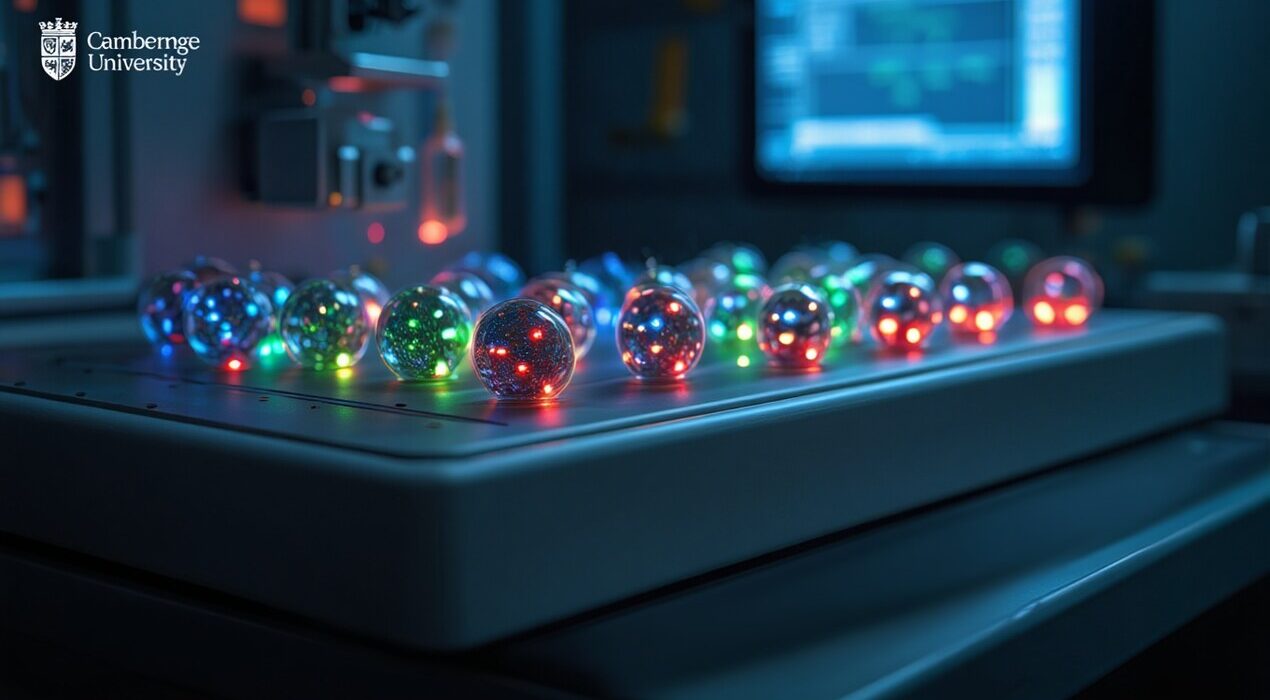
A team at the University of Cambridge has unlocked a technology once thought impossible. They found a way to power insulating nanoparticles using tiny molecular antennas. As a result, they created ultra-pure near-infrared LEDs with exciting future uses.These molecular antennas guide electrical energy into nanoparticles that normally block electricity. This simple but clever idea opens the door to new medical tools, advanced communication devices, and sensitive sensors.
How the Breakthrough Works
The researchers focused on lanthanide-doped nanoparticles, known for producing very pure and stable light. Their light travels well through biological tissue. However, their insulating nature made them difficult to use in electronics.According to Professor Akshay Rao, the team struggled for years to power these particles. He explained that the organic molecules act like antennas that collect charge and pass it to the nanoparticle through a highly efficient energy-transfer process.To achieve this, the team attached an organic dye called 9-anthracenecarboxylic acid to the particles. This dye absorbs the electrical charge first. Then, it moves into a “triplet state” and transfers more than 98 percent of its energy to the nanoparticle. Therefore, the LED lights up with impressive purity.
Cleaner Light and Lower Power Needs
The new LEDs work at only 5 volts. In addition, they produce an extremely narrow light spectrum, which is far purer than the output of many existing technologies.Dr. Zhongzheng Yu explained that this sharp light is very helpful for biomedical sensing and optical communication, where accuracy truly matters.
Big Potential for Medicine and Communication
The team believes this technology could lead to injectable or wearable LEDs for deep-tissue imaging. It could also support faster communication networks and more precise chemical or biological detection.Dr. Yunzhou Deng shared that this is only the beginning. The flexible method allows endless combinations of organic molecules and nanoparticles, making room for many future innovations.