Champagne Cluster Collision Reveals Dark Matter Secrets in Deep Space
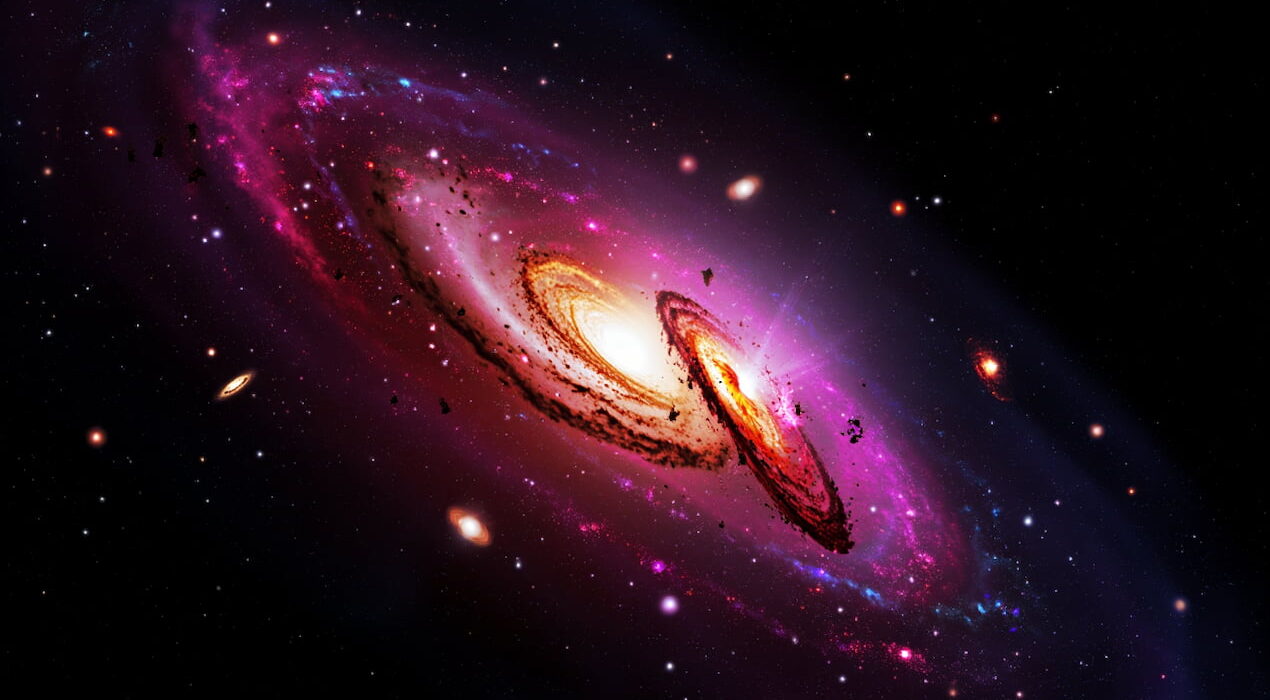
Space rang in the New Year with a cosmic spectacle. Astronomers call it the Champagne Cluster. It offers a rare view of two massive galaxy clusters colliding in deep space. Researchers discovered the system on December 31, 2020. Therefore, its timing inspired the festive name. In addition, its bubbly appearance resembles rising champagne in a glass. A new composite image blends X-ray and optical data. As a result, scientists can study both hot gas and galaxies together.
A Stunning Blend of Space Data
NASA’s Chandra X-ray Observatory captured the superheated gas in purple tones. Meanwhile, optical surveys revealed galaxies in red, green, and blue light.Together, these views show more than 100 galaxies. However, the glowing gas outweighs all those galaxies combined. This detail highlights how extreme these cosmic environments can be.The image reveals two clusters, not one. They are slowly merging into a larger structure. For example, stretched hot gas signals a violent collision.Astronomers also see two galaxy concentrations. One sits above the center, and one below it. As a result, researchers confirmed an ongoing cluster merger.
Dark Matter Matters Here
Dark matter makes up most of the cluster’s mass. Yet, it remains invisible to telescopes. However, collisions like this help scientists track its behavior.The Champagne Cluster resembles the famous Bullet Cluster. Both show offsets between gas and mass. Therefore, they serve as natural laboratories for dark matter research.
Two Possible Collision Stories
Scientists tested the data against simulations. They found two possible timelines. In one, the clusters collided billions of years ago and will collide again.In the other, a single crash happened 400 million years ago. The clusters now drift apart. Continued observations should reveal which story is correct.