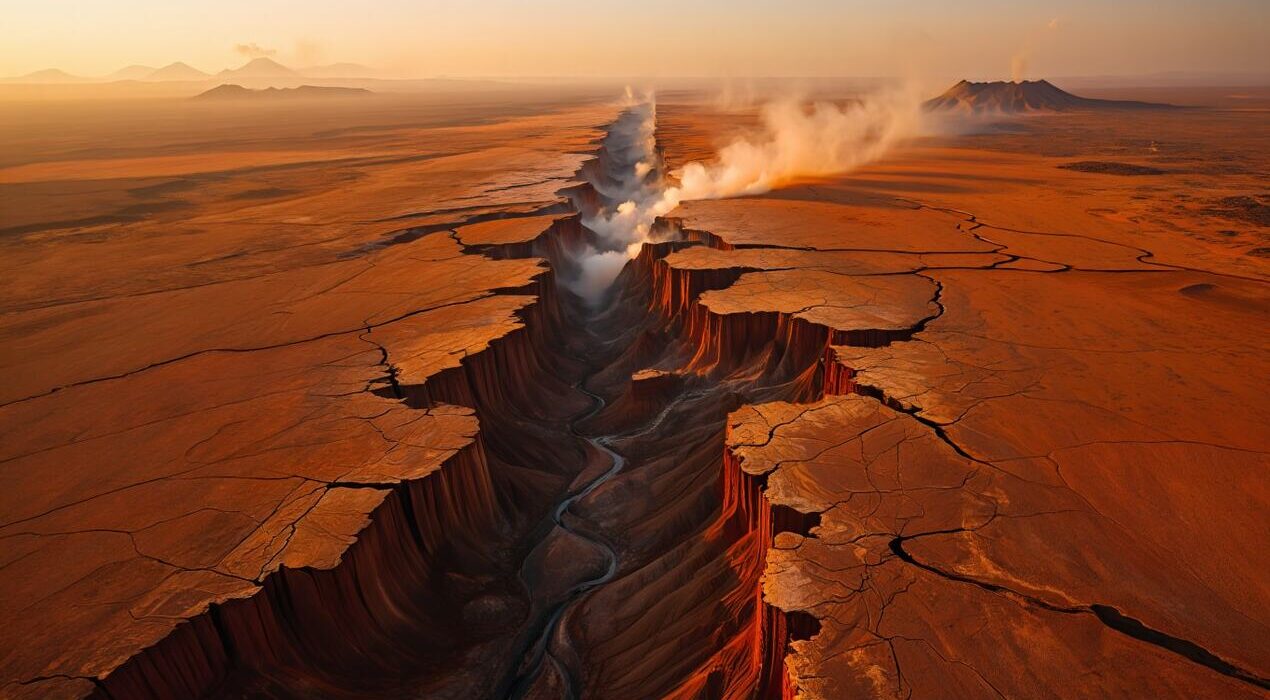
Earth’s Crust Tearing Open in Africa, New Ocean Forming
Eastern Africa is breaking apart. The Turkana Rift spans Kenya and Ethiopia. Here, tectonic plates move apart at 4.7 millimeters per year. As a result, the crust stretches and thins. Scientists now report that thinning has reached a critical stage.
Necking and Thinning
At the rift’s center, the crust is only 13 kilometers thick. Away from the rift, it exceeds 35 kilometers. This sharp difference signals a process called necking. Think of pulling taffy until the middle becomes thin. The thinner crust weakens further. Therefore, continued rifting becomes more likely.
A Future Ocean
Eventually, the crust may split completely. Magma will rise and create new seafloor. Water from the Indian Ocean could then flood in. A new ocean will form. Nevertheless, this will take millions of years. The rift began opening 45 million years ago.
A Front Row Seat
This is the first known active rift undergoing necking. Scientists now have a rare opportunity to observe the process. “We have a front row seat,” says co‑author Folarin Kolawole. The findings challenge traditional ideas about continental breakup.
Rethinking the Fossil Record
The Turkana Rift holds one‑third of all early human fossils. Many researchers considered it a key evolution center. However, necking caused the land to sink. Fine sediments built up rapidly and preserved remains. Therefore, the region may not be special for evolution itself. Instead, geological conditions simply made fossil preservation easier.
Researchers can now test this idea. Tectonic models combined with climate data will reveal more. For now, Africa’s slow breakup offers a window into Earth’s deep future.