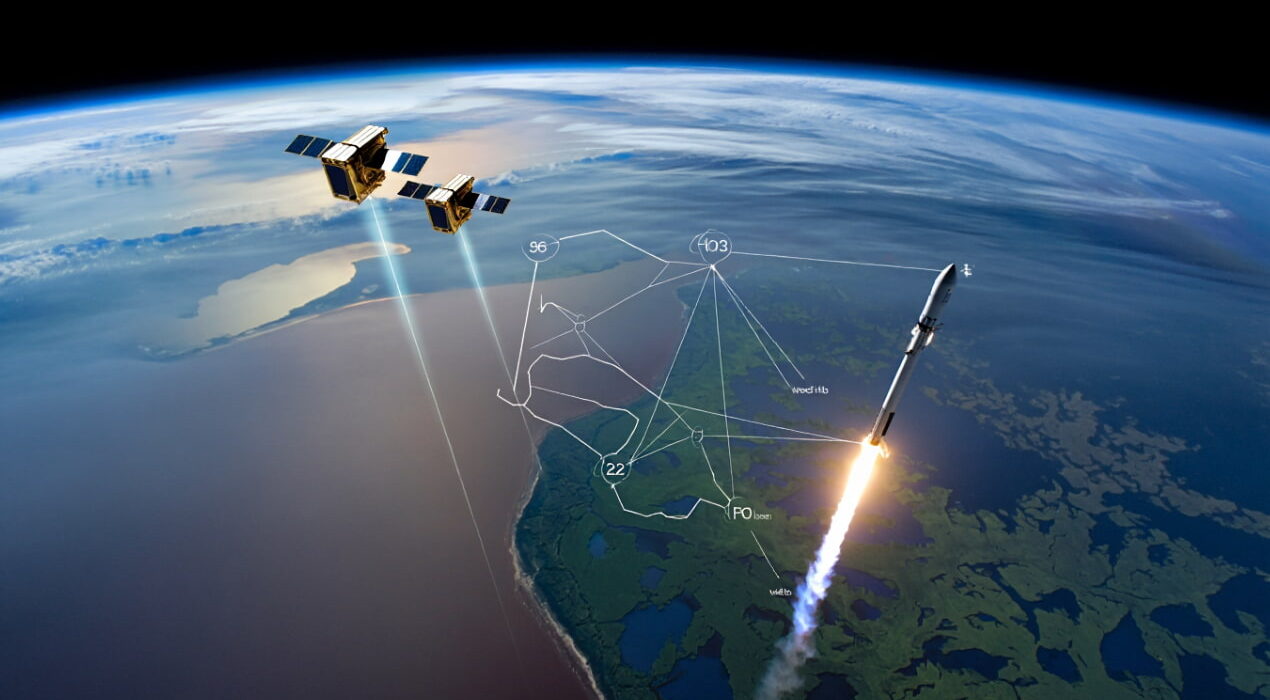
Changes in the global water cycle are reshaping ecosystems and human communities, making accurate monitoring increasingly vital. ESA’s HydroGNSS mission, part of the FutureEO programme, is designed to provide data on four key hydrological parameters: soil moisture, wetlands and inundation, freeze/thaw states, and above-ground biomass. These indicators, classified as Essential Climate Variables (ECVs) by the Global Climate Observing System (GCOS), are central to climate risk assessment, flood prediction, weather modeling, and monitoring carbon stocks in forests and permafrost.
HydroGNSS will also deliver secondary products, including wind speed over oceans and sea-ice extent. This ensures continuity of critical datasets as current missions, such as ESA’s SMOS and NASA’s SMAP, approach the end of their operational lifetimes.
The satellites employ Global Navigation Satellite System (GNSS) reflectometry, a technique that repurposes signals from systems like Galileo and GPS. While these signals primarily enable navigation, their reflections from Earth’s surface carry valuable information about terrain, ice, vegetation, and oceans. By analyzing these reflected signals against direct transmissions, HydroGNSS can extract climate and water cycle data with a resolution finer than 25 km.
The mission includes two microsatellites, orbiting at 500–600 km and spaced 180 degrees apart. Developed by Surrey Satellite Technology Ltd (SSTL) under ESA’s Scout framework, HydroGNSS represents a new generation of agile, cost-effective missions.
-Pascal Lejault, ESA’s Scout Project Manager, emphasized that GNSS reflectometry may become the most affordable and sustainable method for future soil moisture monitoring. He credited SSTL’s expertise in delivering the satellites, which are scheduled for launch later this year aboard a Falcon 9 rocket.
As the first of three Scout missions, HydroGNSS builds on earlier demonstrations like TechDemoSAT-1 and NASA’s CYGNSS, paving the way for innovative science through compact, rapid-deployment satellites.
ESA’s HydroGNSS Mission to Track Global Water Cycle with GNSS Signals