Medieval Diary Reveals Dangerous Solar Event from 1200 CE
The Sun can be beautiful. But it can also be dangerous. Beyond Earth’s magnetic field, solar flares release high-energy particles. These cause solar proton events (SPEs). In 1972, several SPEs struck between two Apollo missions. Astronauts would have faced deadly radiation. Therefore, understanding SPEs is critical for future Moon trips.
How a Medieval Diary Helped
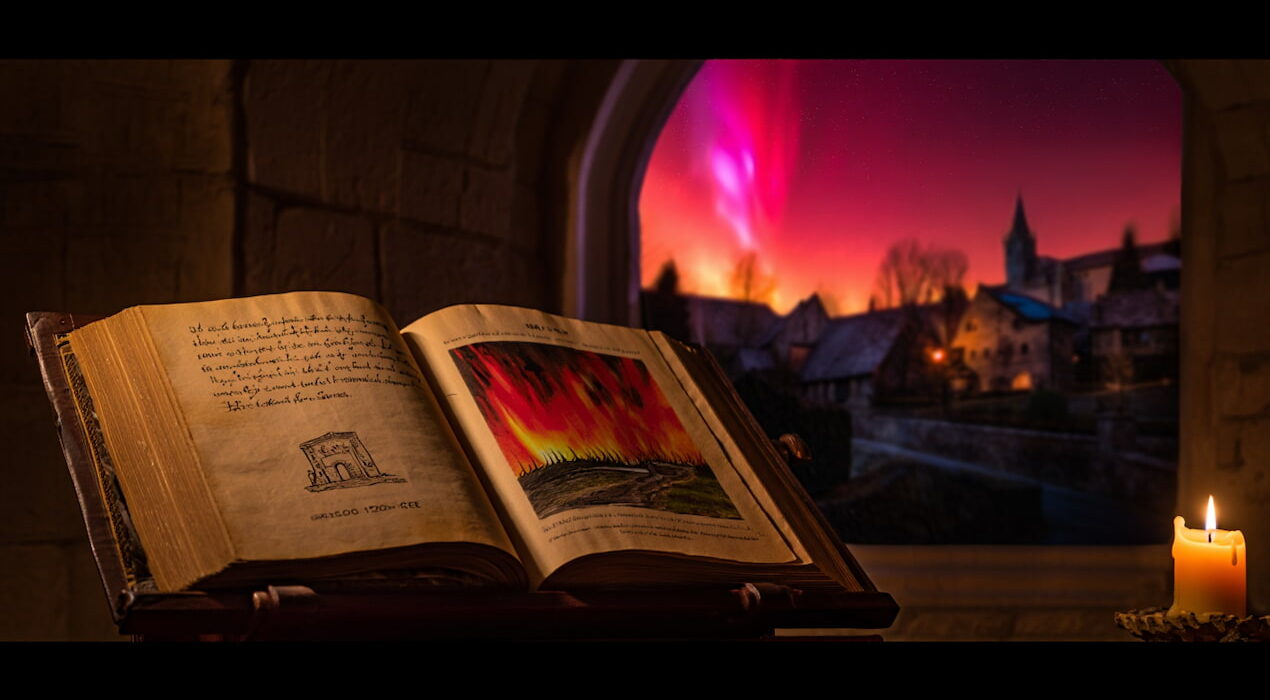
Researchers at OIST developed a new detection method. They combined tree-ring carbon data with historical records. For example, a Japanese diary called Meigetsuki recorded “red lights in the northern sky” in 1204 CE. That clue guided their search. As a result, they found an SPE between winter 1200 and spring 1201 CE. Buried asunaro tree samples from northern Japan confirmed the spike.
Why This Matters Now
Most SPEs are blocked by Earth’s magnetic field. However, near the poles, some particles reach the atmosphere. They create carbon-14, which trees absorb. Using precise carbon-14 analysis, scientists can detect “sub-extreme” SPEs. These are smaller but still hazardous. They happen more often than rare super-storms. The team also learned that the solar cycle back then was only 7–8 years long. Today it is 11 years. That means the Sun was very active.
Better Predictions for Space Weather
Historical literature offers time windows. Tree rings provide exact dates. Together, they improve space weather forecasts. This integrated approach helps protect astronauts. It also fills gaps in our knowledge of past solar activity. “We’re excited to explore what solar conditions caused these events,” says Professor Miyahara.