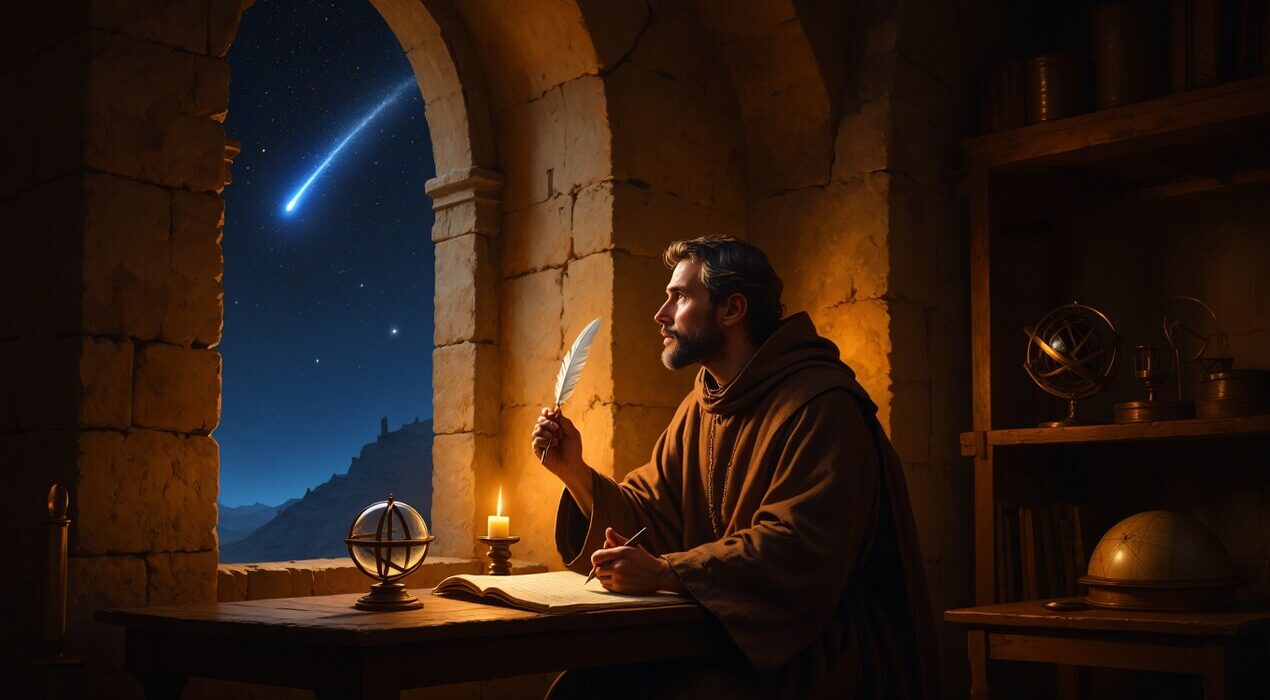
Medieval Monk Knew About Halley’s Comet First, Historians Say
History credits Edmond Halley with discovering the famous comet’s cycle. However, new research suggests someone else figured it out first. An 11th-century monk may have made the connection centuries earlier. Professor Simon Portegies Zwart led this fascinating study. He worked with historians to analyze medieval chronicles. Their findings challenge a long-held astronomical story.
The Monk Who Saw It Twice
The monk, named Eilmer of Malmesbury, lived in the 11th century. He reportedly saw a bright comet in the year 989. Then, he saw another in 1066.Eilmer realized these were the same object returning. He recorded this observation, but modern science overlooked it. As a result, Edmond Halley received the credit much later.
Halley’s Later, Famous Discovery
Edmond Halley made his discovery in the 17th century. He used calculations to link comet sightings from 1531, 1607, and 1682. Therefore, he proved the comet returns roughly every 76 years. The comet was then named in his honor. This was a major step for science. However, the new research shows the pattern was noticed long before.
A Comet of Omens and History
The 1066 appearance was very famous. People across the world, from China to Europe, recorded it. For example, the Bayeux Tapestry famously depicts the comet. Medieval societies often saw comets as bad omens. They linked them to war, famine, or a king’s death. Consequently, these sightings were taken very seriously. The researchers now propose a name change. They believe the comet’s discovery timeline needs correction. “This research was great fun to do,” said Portegies Zwart. They plan more interdisciplinary research on historical comets. This story reminds us that scientific discovery often has deeper, older roots.