Pakistan AI Robotics Push Gets Boost From Chinese Partnerships
A Pakistani company says it can now build most of its AI inspection systems locally. However, Pakistan AI robotics still faces major challenges in precision manufacturing.
Robionix Expands Local Production
Robionix Technologies developed MagicQC to inspect finished garments. The system uses cameras to check measurements against buyer requirements.The garment industry remains vital to Pakistan’s economy. Textile exports reached $17.88 billion during the 2024-25 fiscal year. That figure represented about 56% of merchandise exports.
Founder and CEO Awais Yasin said local production now covers most system components. Only the industrial camera, touchscreen and mounting assembly came from abroad.Pakistani suppliers provide the measurement bed, lighting, computer and electrical parts. Local engineers also handle system integration.Robionix has installed its systems at factories in Karachi, Faisalabad and Sialkot. However, the company still has limited commercial installations.
China Could Help Build Robot Ecosystem
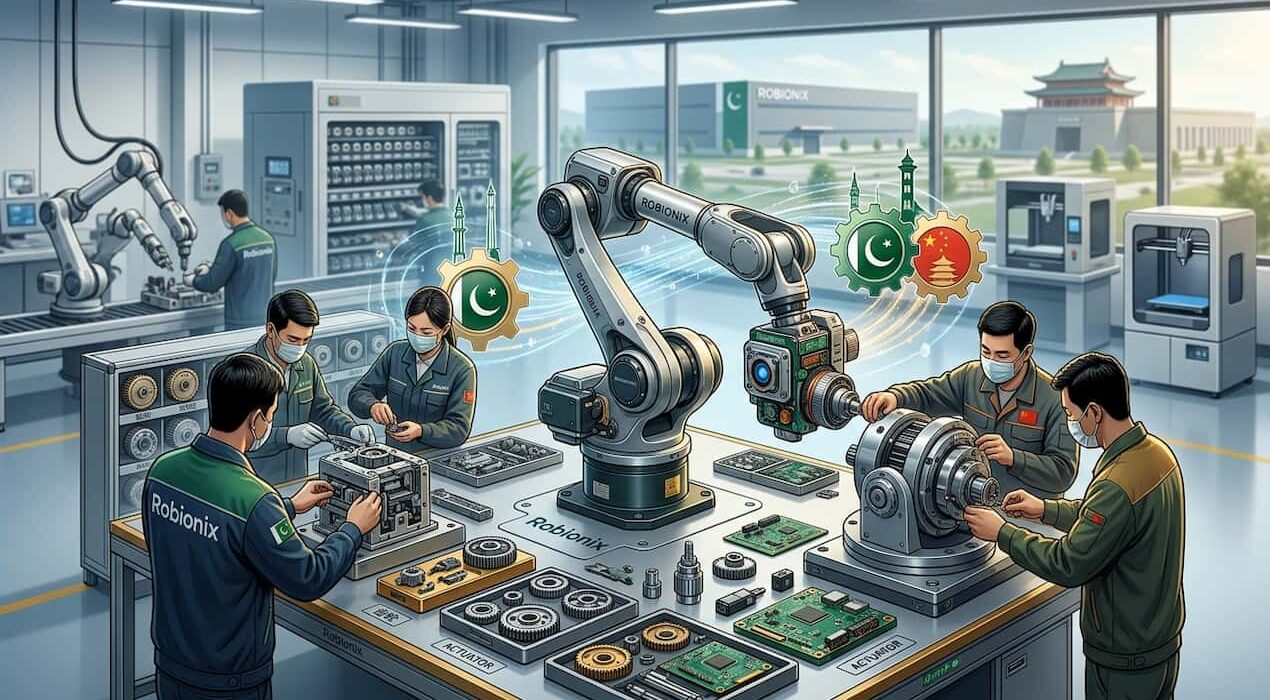
Yasin said building an industrial robot presents a much bigger challenge. Robot arms need highly precise motors, encoders, gear reducers and servo drives.Pakistan currently lacks enough local suppliers for these components. Therefore, the company cannot yet build a fully indigenous six-axis industrial arm.
Robionix can design robot structures, electronics, software and vision systems. However, Yasin says Pakistan needs a stronger precision manufacturing ecosystem.He saw such an ecosystem while studying robotics at Beijing Institute of Technology. Chinese universities, suppliers and factories work closely to develop and deploy robotics.China installed 295,000 industrial robots in 2024. That represented 54% of global installations, according to the International Federation of Robotics
Yasin believes Chinese companies could help Pakistan close this industrial gap. He supports joint laboratories, defined localisation targets and long-term engineering training.The proposed cooperation could begin with local assembly and integration. Later, Pakistani manufacturers could produce critical components themselves.Such partnerships could strengthen Pakistan’s industrial automation sector. They may also create new opportunities for engineers, manufacturers and technology companies.