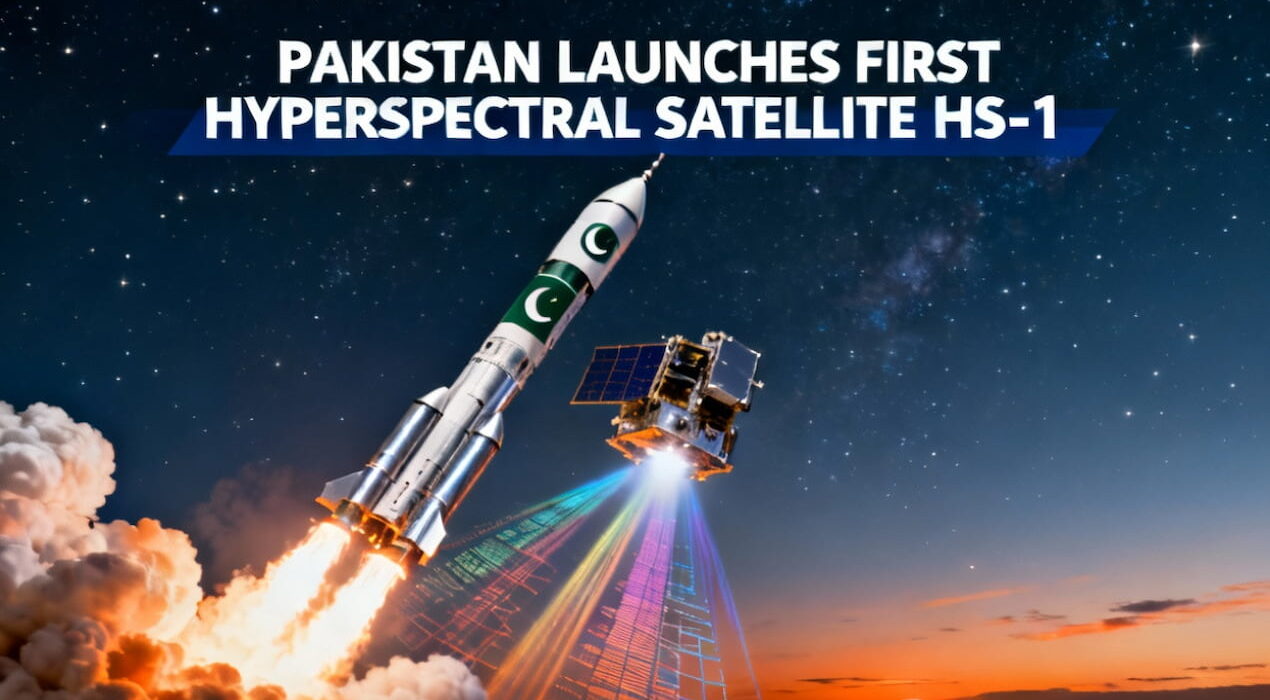
Pakistan Launches First Hyperspectral Satellite HS-1, Ushering a New Space
Pakistan has entered a new era in space technology. The Pakistan Space and Upper Atmosphere Research Commission (SUPARCO) has successfully launched the country’s first Hyperspectral Satellite (HS-1) from China. The historic mission marks a major step forward in Pakistan’s scientific and technological journey.
The Pakistan Hyperspectral Satellite represents a major breakthrough in advanced space imaging. It captures highly detailed hyperspectral data across hundreds of narrow spectral bands. This technology helps analyze land, vegetation, water, and urban structures with remarkable accuracy. Therefore, HS-1 will support precision agriculture, environmental protection, and disaster management.
Transforming Development Through Space Science
Chairman SUPARCO, Muhammad Yousaf Khan, congratulated the nation on this remarkable success. He thanked the Government of Pakistan for its strong support in making the project possible. He emphasized that HS-1 will revolutionize agriculture, improve climate resilience, and optimize natural resource management.
Through its advanced imaging, HS-1 will map crop health, soil moisture, and water quality. It will also monitor deforestation, pollution, and glacial melt. In addition, it will enhance early warning systems for floods and landslides, especially in northern regions. The data will help planners and scientists make better decisions for sustainable development.
Strengthening Pakistan–China Space Partnership
The launch highlights deep cooperation between Pakistan and China in space science and technology. Both nations continue to work together on peaceful space exploration and research.
Project Director HS-1, Mushtaque Hussain Soomro, praised the mission team for its dedication and expertise. He stated that the launch strengthens Pakistan’s position as an emerging leader in space technology for sustainable progress.