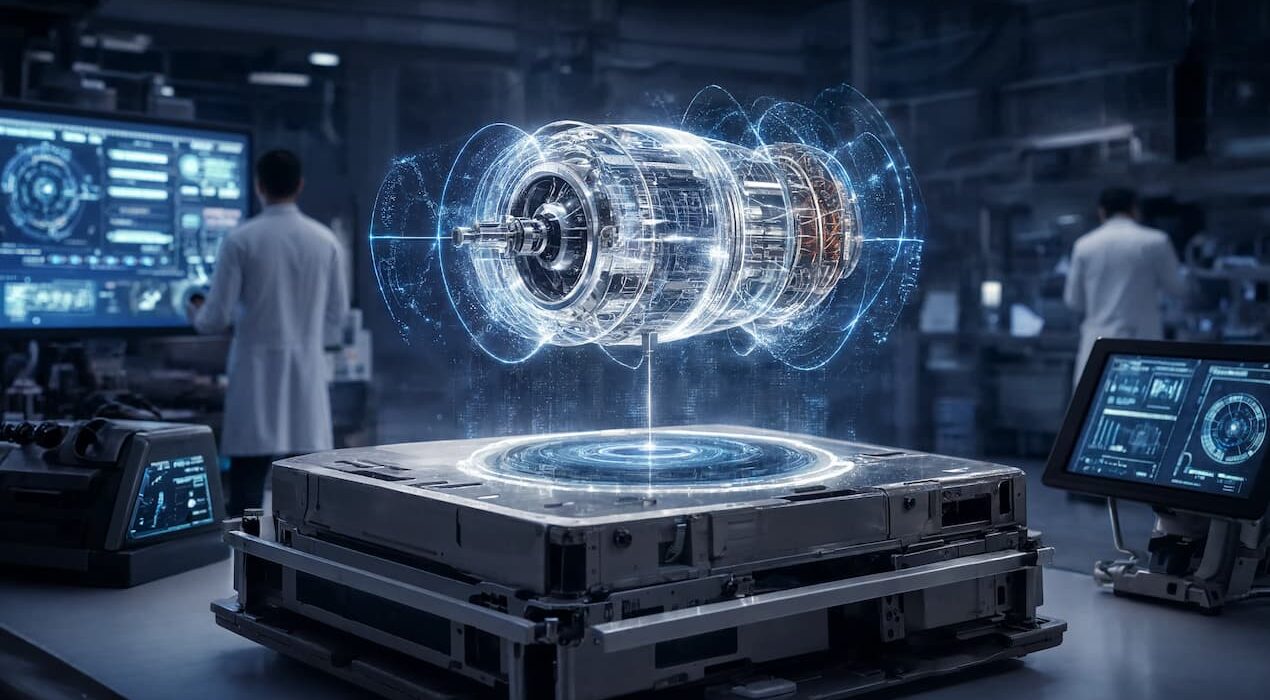
Plastic Motor Breakthrough Challenges Traditional Engineering
A remarkable plastic motor breakthrough could reshape how engineers design future machines. Researchers at the Institute of Science Tokyo created a working motor without magnets or metal rotors.
For more than a century, engineers relied on magnetic fields to power motors. However, this new discovery suggests another approach may be possible.
An Overlooked Force Gains Attention
Most electric motors use magnetism to generate movement. Scientists considered electrostatic forces too weak for practical applications. Researchers decided to revisit that assumption using special materials called ferroelectric fluids. These unusual liquids react strongly to electric fields.
The team placed the fluid between two closely spaced electrodes. When they applied voltage, the liquid moved sideways against gravity. The movement reached nearly 10 centimeters. In contrast, ordinary liquids showed no similar behavior.
Scientists also noticed something unexpected. Small increases in voltage produced proportional increases in force.
Further analysis revealed the cause. Electric fields aligned molecules inside the liquid, creating a powerful sideways push. This finding demonstrated that electrostatic effects can become much stronger under specific conditions. As a result, researchers explored new ways to use this force.
A New Type of Motor
Inspired by the results, the team built a prototype motor. Unlike traditional designs, the motor required no magnets. The researchers also replaced the metal rotor with a plastic one. Surprisingly, the plastic rotor rotated successfully during testing. This design offers several potential advantages. For example, manufacturers could reduce dependence on rare earth materials.
Plastic components may also lower weight and improve responsiveness. Therefore, the technology could benefit robotics and precision devices.
Another advantage involves reduced magnetic interference. Consequently, the motor may perform well in medical systems and data-sensitive environments. The device also operates at lower voltages than many electrostatic systems. This feature could improve safety and practicality.
Although further development remains necessary, the results challenge long-standing engineering beliefs. If the technology advances, future motors may become lighter, simpler, and less dependent on scarce materials.