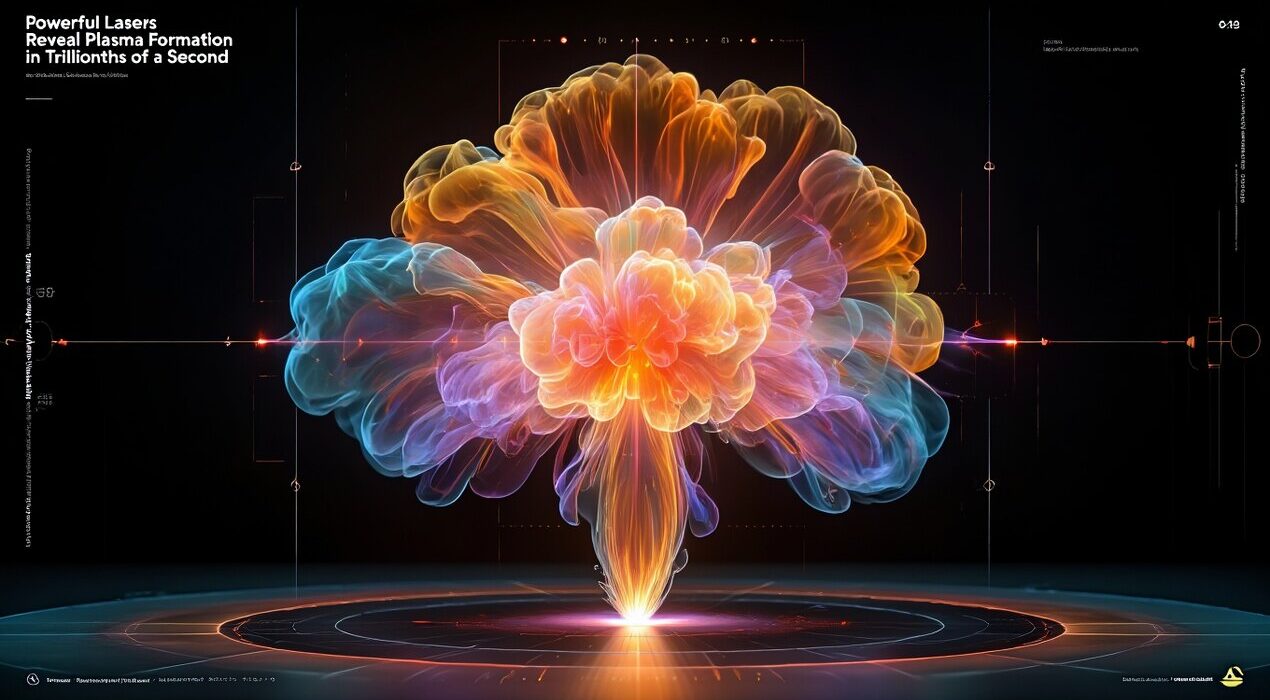
Powerful Lasers Reveal Plasma Formation in Trillionths of a Second
Intense laser pulses can strip electrons from atoms. This process creates superhot plasma. Researchers at HZDR in Germany observed this in record detail. They combined two advanced laser systems. As a result, they captured changes within picoseconds. That is trillionths of a second.
The Pump Probe Method
The experiment used a thin copper wire. A powerful laser vaporized it instantly. The wire reached several million degrees. Copper atoms lost many electrons and became highly ionized. A second laser pulse followed shortly after. This probe pulse measured the plasma’s evolution. Therefore, scientists could track step-by-step changes.
A Clear Timeline
The X‑ray probe tuned to a specific copper ion (Cu²²⁺). These ions appeared almost immediately. Their numbers peaked after about 2.5 picoseconds. Then recombination began. After roughly 10 picoseconds, the ions were gone. “No one has ever looked at this precisely before,” says Professor Tom Cowan.
Laser fusion also relies on extremely hot plasma. Understanding plasma formation improves reactor design. The team’s computer simulations explained the physics. Energetic electrons knock out more electrons like a wave. Eventually, those electrons get recaptured. The atoms return to a neutral state.
Future Applications
“This experiment demonstrates how powerful our lasers are,” says Dr. Ulf Zastrau. It paves the way for future laser fusion facilities. Better simulations will help build efficient
fusion reactors. This research also applies to astrophysics and space phenomena