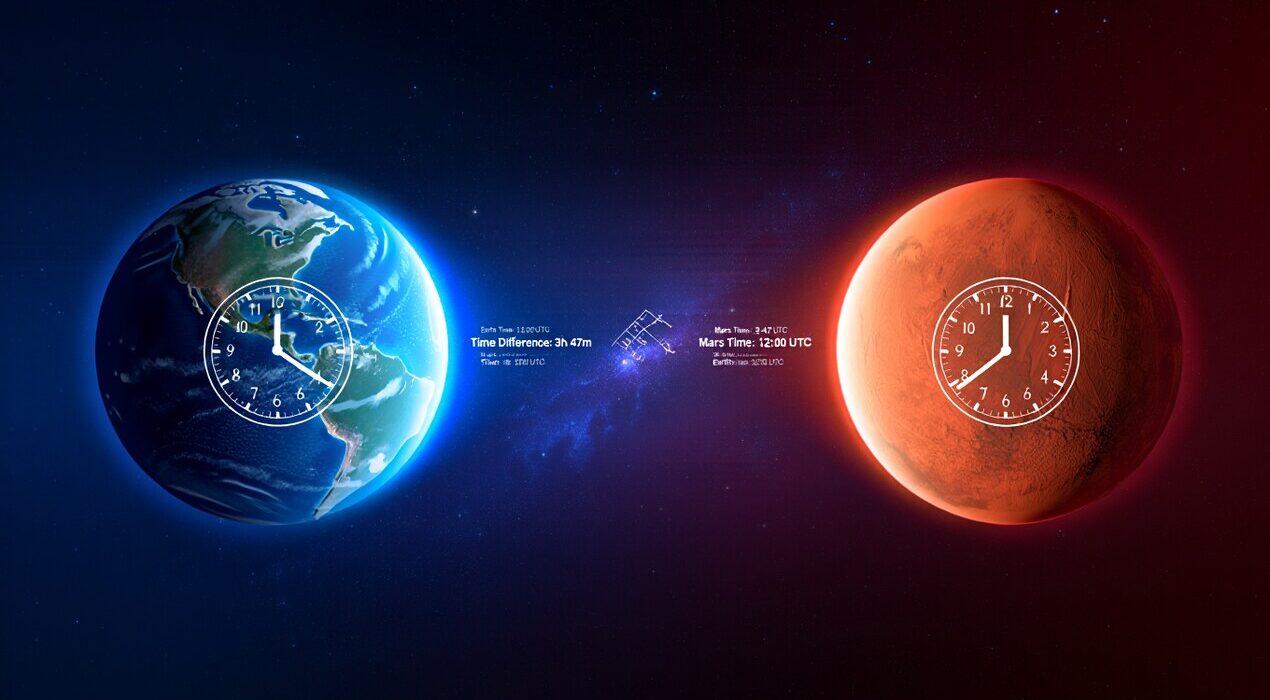
Scientists Calculate Exact Time Difference Between Earth and Mars
Time does not move the same way everywhere in space. New research shows that Mars experiences time differently than Earth. This discovery matters for future missions and long-distance communication.Physicists at the National Institute of Standards and Technology led the study. They tracked how gravity and motion affect time on Mars. As a result, they identified small but important differences.
How Fast Does Time Pass on Mars
According to the researchers, time on Mars runs slightly faster. A clock on Mars gains about 477 microseconds per day compared with Earth. However, this difference changes over the Martian year.Mars follows an elongated orbit around the Sun. Therefore, its distance from the Sun constantly shifts. These changes can adjust the time difference by up to 226 microseconds.
Why Calculating Mars Time Is Complex
Einstein showed that gravity influences time. Clocks tick slower in stronger gravity and faster in weaker gravity. Since Mars has weaker gravity, time moves faster on its surface.Scientists also included effects from nearby objects. For example, the Sun, Earth, and Moon all influence Mars. This creates a complex interaction that requires advanced modeling.
Importance for Space Missions
Knowing the exact time on Mars supports accurate navigation. It also improves communication planning between planets. As a result, missions can operate more smoothly.NIST physicist Bijunath Patla explained that timing accuracy builds the foundation for a future solar system network. Better synchronization could reduce errors during spacecraft operations.Communications between Earth and Mars currently take minutes. Even so, precise clocks still matter. Modern networks rely on near-perfect timing to transfer data.This research helps scientists prepare for long-term exploration. It also expands knowledge of how relativity works beyond Earth. Understanding time on Mars brings science fiction closer to reality. Each calculation strengthens humanity’s path toward deeper space exploration.