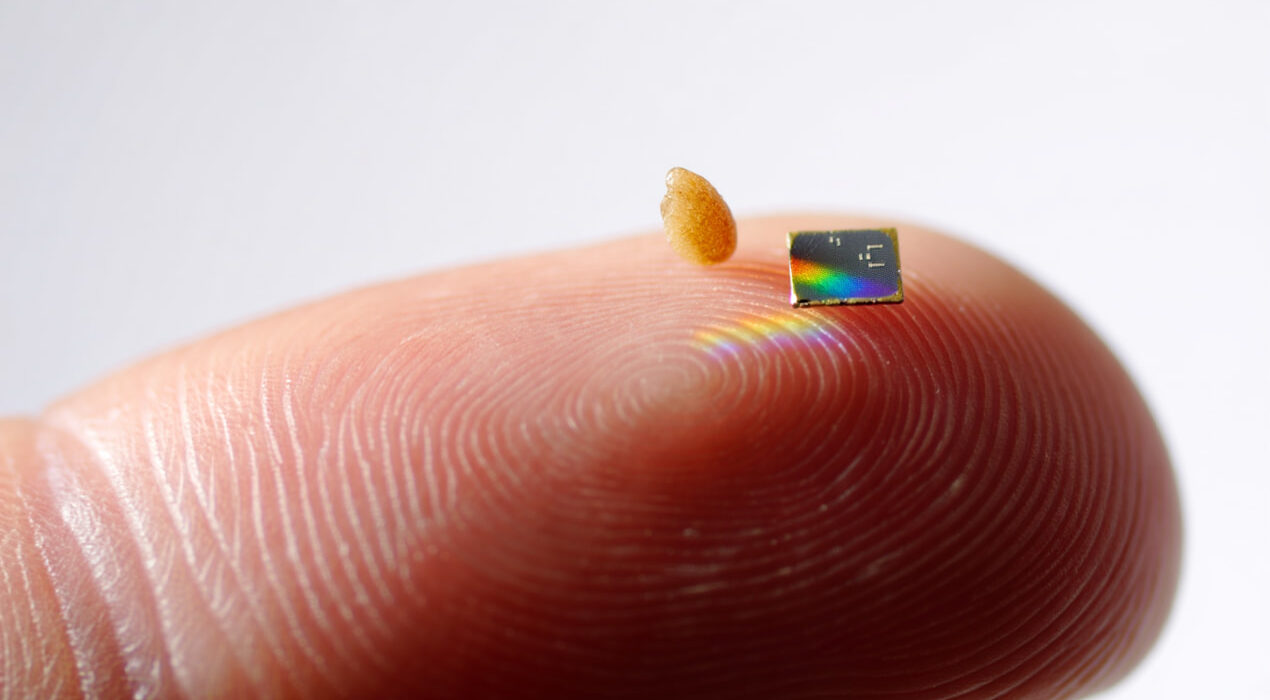
Scientists Shrink Spectrometer to Chip Smaller Than a Grain of Sand
Scientists have created a spectrometer smaller than a grain of sand. This device could replace large lab equipmentResearchers at University of California, Davis developed this new technology. It offers a compact and portable solution for analyzing materials.
Why Spectrometers Matter
Spectrometers help scientists study materials. They analyze light to reveal chemical composition.For example, they help detect diseases and check food quality. They also monitor pollution levels.However, traditional machines are large and expensive. Therefore, they are not easy to carry or use widely.This new chip works differently. Instead of splitting light, it uses computational reconstruction.The device uses 16 tiny silicon detectors. Each detector responds slightly differently to light.As a result, they capture overlapping signals. Artificial intelligence then rebuilds the full spectrum.
How AI Makes It Possible
The system uses a neural network to process data. It learns from large datasets during training.Therefore, it can interpret complex signals accurately. This method solves what scientists call an “inverse problem.”In addition, the device achieves high precision. It can measure light with strong accuracy.Silicon usually struggles with near-infrared light. However, researchers improved its performance.They added special surface textures to trap photons. As a result, the chip detects a wider range of light.This feature is useful in medical imaging. Near-infrared light can pass through tissues more easily.
Small Size, Big Impact
The device measures just 0.4 square millimeters. Despite its size, it performs complex analysis.It also resists noise and interference. Therefore, it works well in real-world conditions.According to SPIE, this innovation could transform sensing technology.Scientists plan to integrate the chip into portable devices. This could enable real-time testing anywhere.In conclusion, this tiny spectrometer marks a major step forward. It may change healthcare, food safety, and environmental monitoring.