Robot Swarm Efficiency Boost: Random Motion Prevents Traffic Jams
Researchers at Harvard John A. Paulson School of Engineering and Applied Sciences discovered an unexpected way to improve robot performance. Their study shows that a small amount of randomness can prevent congestion. As a result, robots complete tasks faster in crowded spaces.Imagine dozens of robots working inside a limited area. Initially, adding more robots increases productivity. However, excessive numbers create traffic jams that slow progress. Researchers wanted to find the ideal balance between speed and crowding.
Random Movement Helps
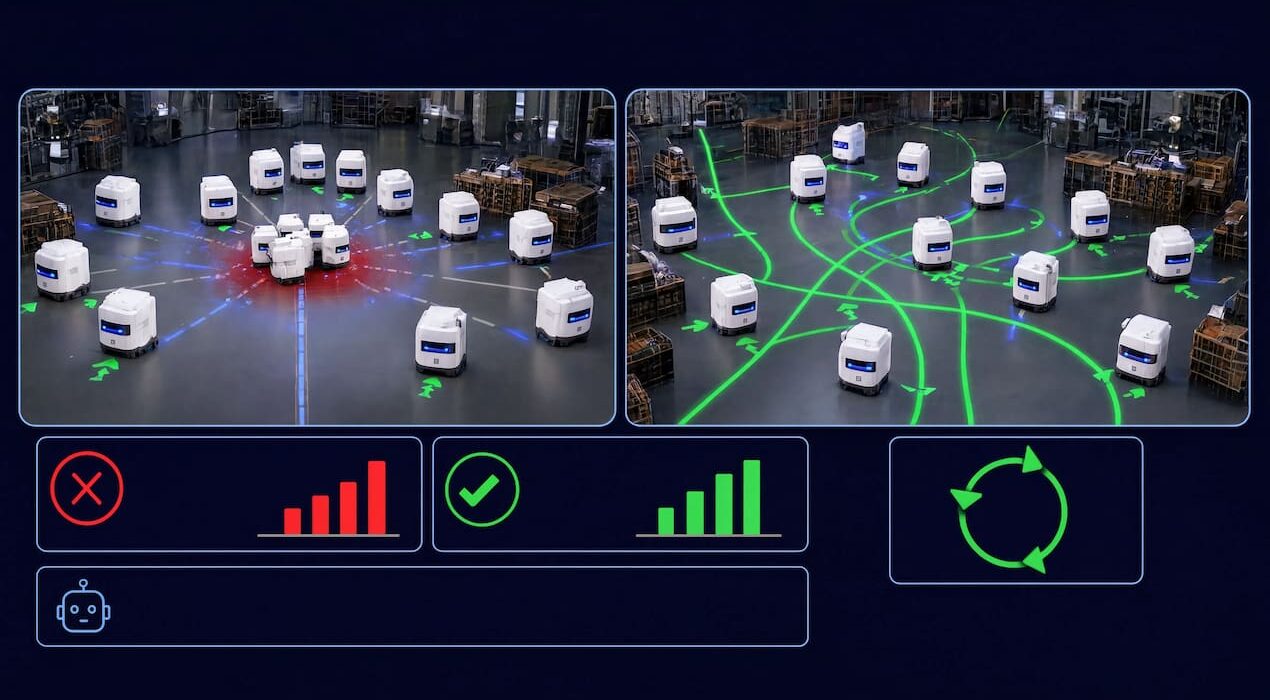
The research team explored how robots behave in dense environments. They used mathematical models, computer simulations, and real-world testing. Their goal was to understand how robots move efficiently around one another. Instead of forcing robots to travel in perfect lines, the team added slight movement variations. These small adjustments helped robots avoid collisions. Therefore, the group maintained steady movement even in crowded conditions.
Computer simulations revealed an important pattern. Straight-line movement often caused severe bottlenecks. On the other hand, excessive randomness reduced efficiency because robots wandered too much. The best results appeared in the middle range.Researchers described this balance as a “just right” level of movement variation. At that point, robots avoided gridlock while still reaching destinations quickly.
Real-World Tests Confirm Findings
The team later tested small wheeled robots in a laboratory setting. Cameras tracked every robot and updated positions continuously. Although real robots moved less precisely than simulated versions, the results matched closely.Moderate randomness consistently improved performance. Robots avoided congestion and completed more tasks over time. Consequently, overall productivity increased without requiring complex control systems.The findings suggest that simple local rules can create highly organized behavior.
Furthermore, robot designers may not need advanced centralized control for every situation.These insights extend beyond robotics. Similar principles could improve vehicle traffic, warehouse operations, and crowd management. Researchers believe carefully balanced flexibility may help many systems operate more efficiently.In short, the study shows that perfect order is not always best. Sometimes, a little randomness creates smoother movement and better results.