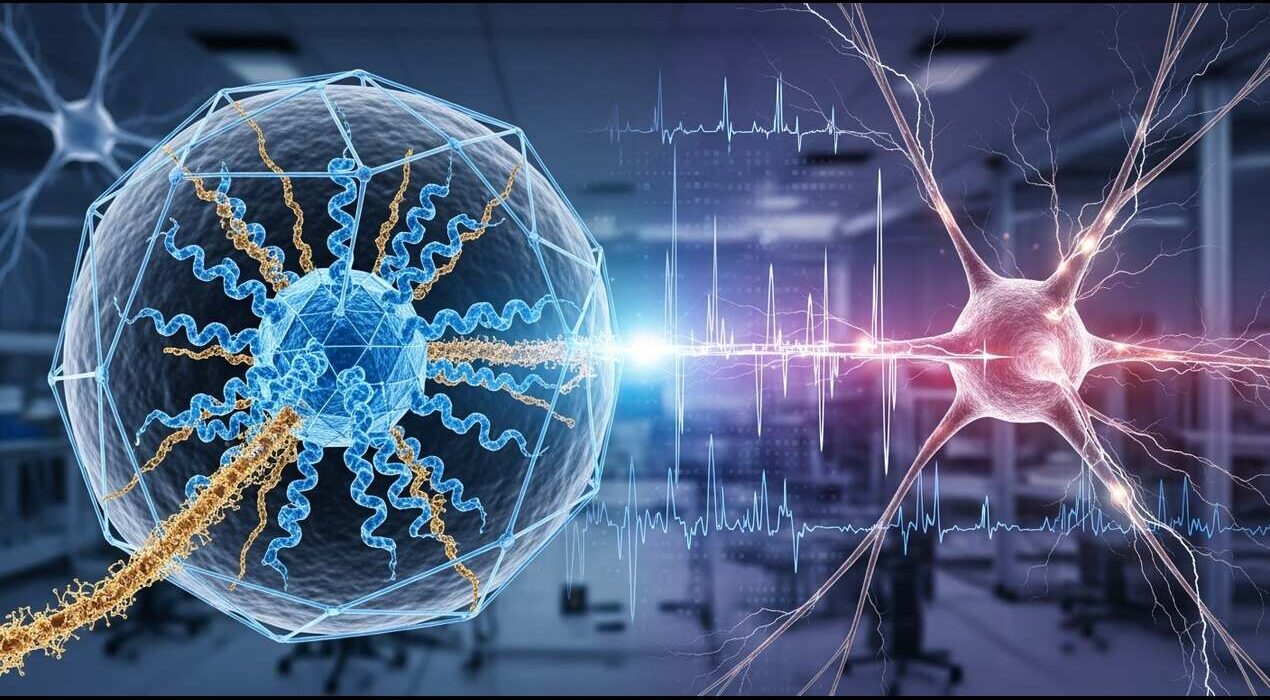
A Breakthrough in Bio-Inspired Computing
Scientists at the University of Massachusetts Amherst have achieved a major milestone in neuroscience and computing.
They have built the first artificial neuron that communicates directly with living ones — using protein nanowires grown by electricity-producing bacteria.
This low-power design could revolutionize how computers interact with biological systems. It may also pave the way for energy-efficient, bio-inspired machines.
Lead researcher Shuai Fu explains, “Our brain handles massive data while using very little energy. Large AI systems, however, consume megawatts of power.”
Efficiency Inspired by Nature
The human brain contains billions of neurons but runs on about 20 watts of power — roughly the same as a light bulb.
In contrast, large computer models require thousands of times more energy.
Co-author Jun Yao notes, “Previous artificial neurons used 10 times more voltage and 100 times more power than ours.”
Their new model operates at 0.1 volts, the same as natural neurons. Therefore, it can safely connect with living cells — something earlier designs couldn’t achieve.
Smarter, Greener Technology
These artificial neurons could transform wearable devices, medical sensors, and future computers.
“Current wearable systems need signal amplification before computers can read them,” Yao says.
“Using our low-voltage neurons removes that step, cutting both power use and circuit complexity.”
The secret lies in Geobacter sulfurreducens, a bacterium that produces electricity.
Its protein nanowires have already powered biofilms, detected diseases, and even generated electricity from air.
As a result, this innovation marks a big step toward computers that truly speak the language of the brain — efficiently, naturally, and sustainably.