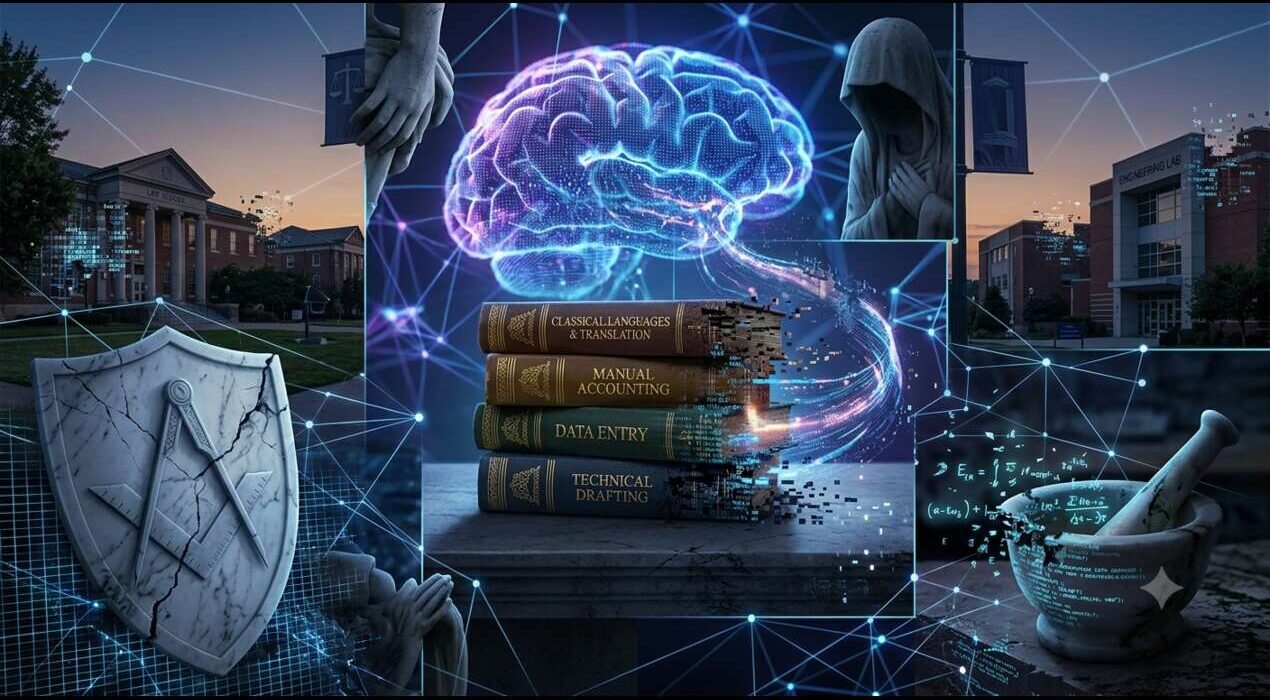
AI Impact on Degrees: Which University Programs Face the Biggest Challenge?
The AI Impact Degrees debate is growing as artificial intelligence transforms workplaces around the world. Many experts believe automation is changing the value of some university programs. Therefore, graduates now face a job market that demands more specialized and adaptable skills. Companies increasingly use AI tools to perform tasks once handled by entry-level employees. As a result, concerns are rising about the gap between university education and workplace requirements. Major layoffs and corporate restructuring have also increased fears that technology is advancing faster than academic curricula. However, experts stress that degrees still hold value when graduates combine them with practical skills and continuous learning.
Several Degree Programs Face Growing Pressure
Business administration, marketing, communications, and media studies are among the fields experiencing significant change. AI tools can now conduct market analysis, draft reports, and create content efficiently. Consequently, employers often seek candidates with specialized expertise rather than broad qualifications.
Journalism and media careers are also evolving. AI can generate summaries, articles, and headlines in seconds. However, investigative reporting and original storytelling continue to require human judgment. Similarly, AI can review legal documents and perform research tasks, reducing demand for some junior legal roles. Yet courtroom advocacy and complex legal strategy remain difficult to automate.
Computer science, accounting, finance, and graphic design also face disruption. AI now assists with coding, bookkeeping, financial modelling, and visual creation. Nevertheless, professionals with advanced technical skills, strategic expertise, and creative leadership remain highly sought after. These fields continue to offer strong opportunities for specialists.
Adaptability Becomes the Key to Success
Experts emphasize that no degree is becoming completely obsolete. Instead, success increasingly depends on adaptability and specialization. Graduates who develop leadership, creativity, emotional intelligence, and problem-solving skills are more likely to stay competitive.
Traditional humanities and English literature programs also remain relevant when combined with practical applications. For example, content strategy, research, storytelling, and communication skills continue to support many industries. Moreover, employers value professionals who can work effectively alongside emerging technologies.
As artificial intelligence continues to evolve, the future of work will depend on continuous learning. The most successful professionals will not only understand their fields but also know
how to integrate AI into their daily work. In the years ahead, adaptability may become the most valuable career skill of all.