Ancient Microbes in Rocks Reveal How Complex Life Began
Stromatolites look like dark, lifeless rocks. However, they are actually living microbial mats. These structures have shaped Earth for billions of years. For example, they produced oxygen through photosynthesis. That oxygen made complex life possible. Now, scientists found something surprising inside them. A team led by Associate Professor Brendan Burns discovered a new microbe. It lives in close partnership with another organism.
Clues to the Origin of Complex Cells
This microbe belongs to the Asgard archaea group. Scientists believe these are the closest relatives to eukaryotes. Eukaryotes are the cells that make up plants, animals, and humans. How did the first complex cell form? One theory says an ancient archaeon partnered with a bacterium. Eventually, one engulfed the other. This process created mitochondria, our cells’ energy powerhouses.
Direct Evidence Found at Shark Bay
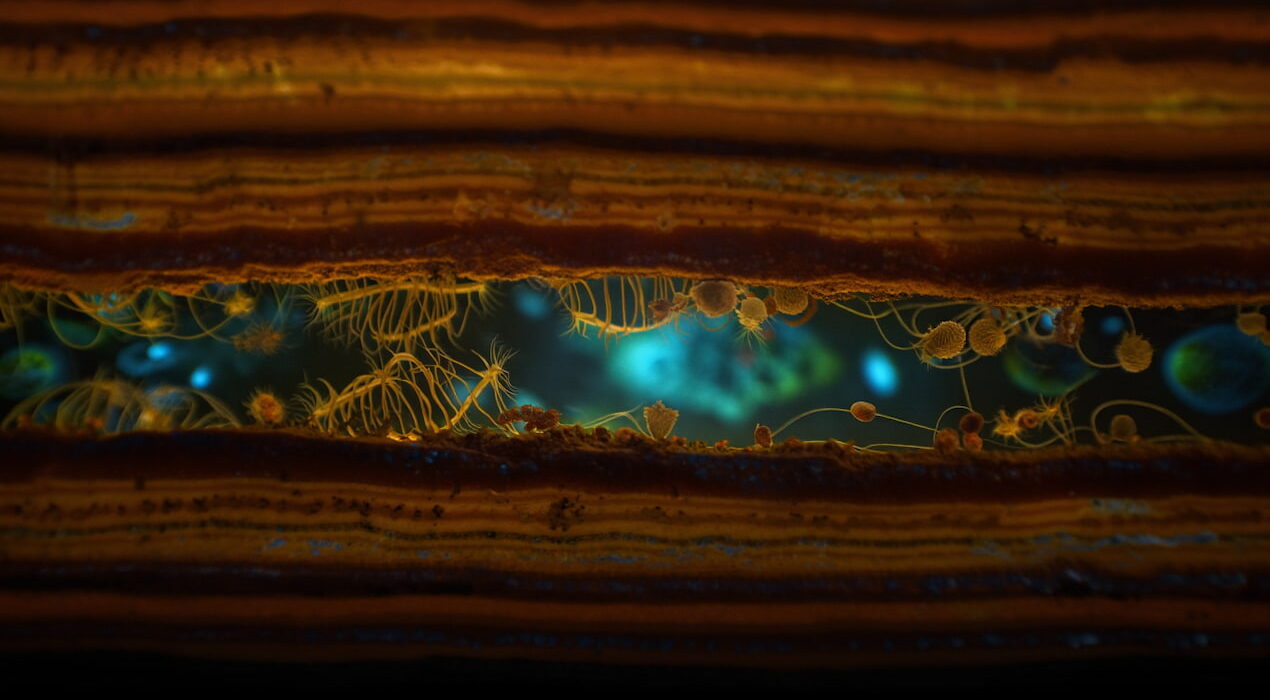
The team collected samples from Shark Bay, Australia. There, they saw something never captured before. The Asgard archaeon connected to a bacterium through tiny nanotubes. These tubes allow the two to share vitamins and nutrients. “This could be a little model for how these partnerships started,” says A/Prof. Burns.
Why Cooperation Matters for Survival
The researchers could not grow the archaeon alone. That suggests it always depends on others. In addition, they used advanced 3D imaging and deep learning to confirm the connection. The new microbe is named Nerearchaeum marumarumayae. The name honors the Malgana people, traditional custodians of Shark Bay. Elders helped choose the words respectfully. Therefore, these tiny partners offer a big lesson. Cooperation has been essential for billions of years. As A/Prof. Burns notes, “Even the smallest partners can leave the deepest mark on our history.”