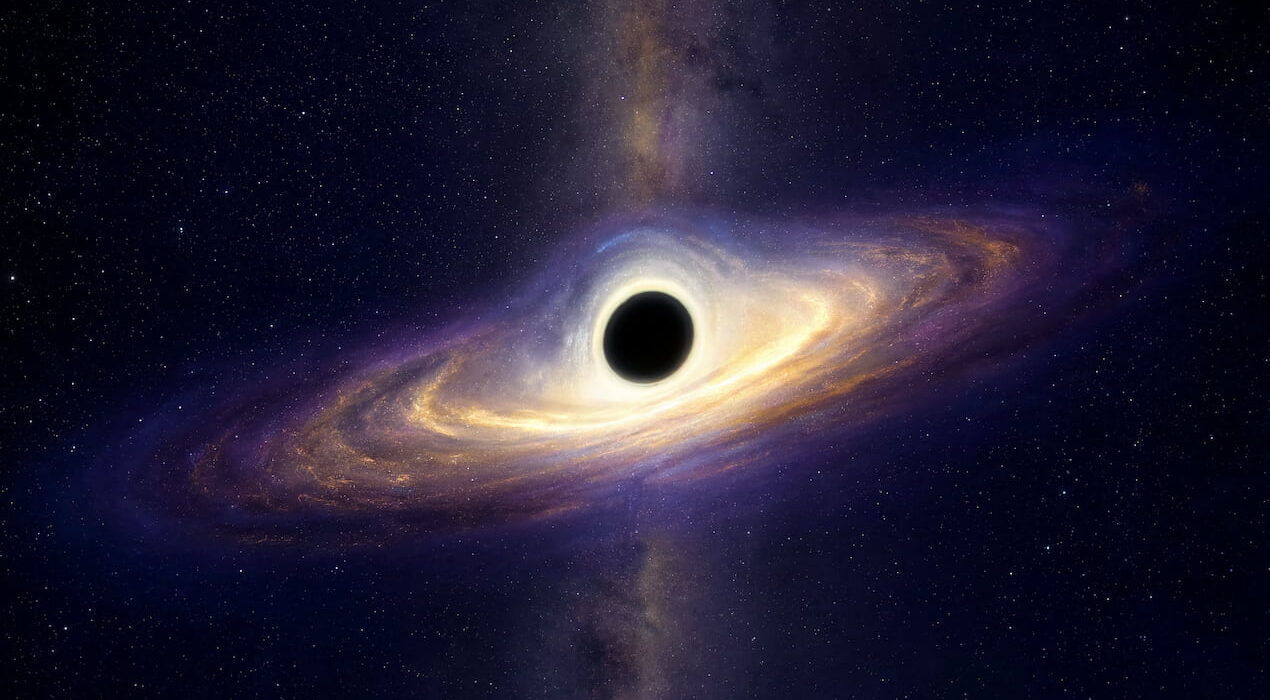
Dormant Black Hole Found by JWST
Astronomers have discovered a dormant black hole more than 10 billion light‑years away. The object weighs six billion times the Sun’s mass.
A Sleeping Giant
The black hole lies in the galaxy MRG‑M0138. Researchers observed it when the universe was only three billion years old. Unlike quasars, which shine brightly as they consume gas, this black hole is inactive.
Scientists used the James Webb Space Telescope (JWST) to measure stellar motions around the galaxy’s center. By tracking how stars moved, they calculated the black hole’s mass. This marks the first time stellar dynamics have been applied at such a vast distance.
Gravitational Lensing Helps
Normally, observing stars in such a distant galaxy is impossible. However, a foreground galaxy magnified MRG‑M0138 through gravitational lensing. This natural effect enlarged the image thirty times, allowing researchers to study its internal structure.
Professor Richard Ellis of UCL explained: “By measuring stellar motions, we can now weigh black holes in the early universe. This opens the door to a more complete census of their growth. ”Black holes and galaxies evolve together. Nearby galaxies show a link between galaxy mass and black hole mass. Studying distant dormant black holes helps reveal how this relationship began.
MRG‑M0138 no longer forms stars. Researchers believe its black hole once powered a quasar. As it grew, the energy released may have expelled gas, shutting down star formation.
The Takeaway
This discovery provides rare insight into galaxy evolution. Future JWST observations may uncover more dormant black holes. These findings could explain how black holes suppress star formation and how they later reignite.