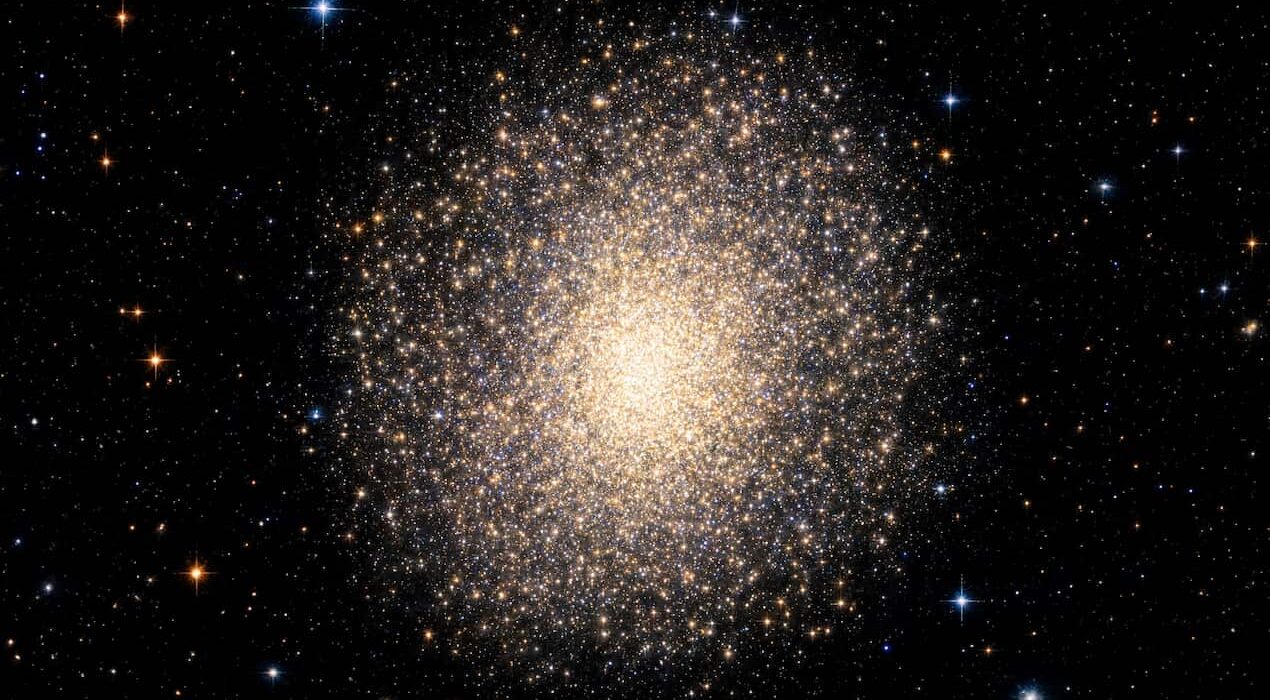
Hubble Reveals Ancient Star Cluster With 500,000 Stars
NASA’s Hubble Space Telescope captured an ancient star cluster with more than 500,000 stars. The stunning image celebrates America’s 250th anniversary. It also highlights Messier 3, one of the Milky Way’s largest globular clusters.
Why Messier 3 Fascinates Astronomers
Messier 3 contains hundreds of thousands of ancient stars. Gravity keeps these stars tightly packed inside a spherical shape. Scientists believe they formed from the same cloud of gas billions of years ago.Moreover, Messier 3 sits far from the Milky Way’s center. It also contains more than 240 RR Lyrae variable stars. These stars brighten and dim in a predictable pattern. Therefore, astronomers use them to measure cosmic distances with high accuracy.The cluster also hosts around 70 possible blue straggler stars. These bright blue stars appear much younger than nearby stars. However, scientists think they gained extra material from companion stars. As a result, they became hotter and brighter without actually being young.
A Window Into the Milky Way’s Past
Researchers believe Messier 3 formed after two globular clusters merged. The cluster contains two separate stellar populations. This evidence suggests an ancient cosmic collision.Scientists think both original clusters belonged to a dwarf galaxy. Later, the Milky Way absorbed that smaller galaxy. Consequently, Messier 3 became part of our galaxy.Hubble observed Messier 3 several times over the years. These observations reveal its detailed structure and unique stars. Blue stars appear hotter, while red stars remain cooler. The telescope assigns these colors using different light wavelengths.Finally, this image supports a Hubble Treasury program. The project studies many globular clusters across the Milky Way. Scientists hope these observations will explain how our galaxy formed and evolved. Meanwhile, Hubble continues working with the James Webb Space Telescope and the upcoming Nancy Grace Roman Space Telescope to uncover more cosmic history.