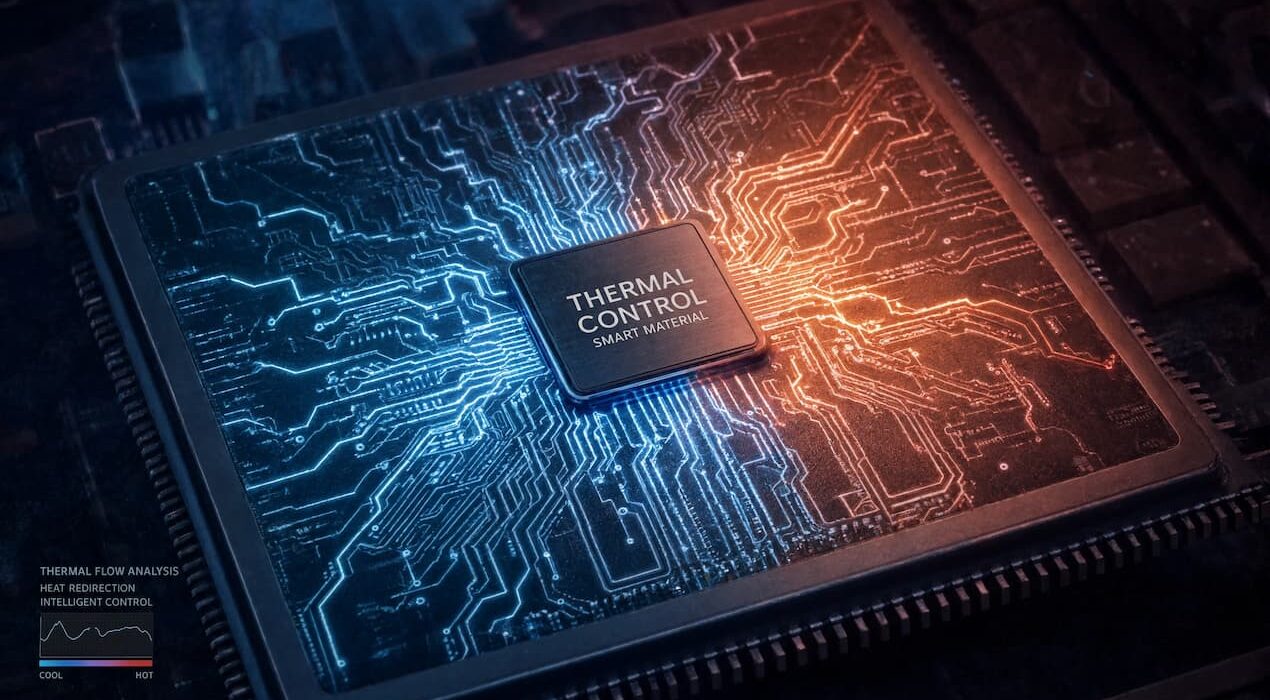
Smart Heat Control Material Works Like a Computer Chip
Scientists have developed a smart heat material that controls heat like a computer chip. The innovation could improve energy systems, sensors, and future memory devices. Researchers designed the material to direct heat with greater accuracy than ever before. Usually, materials absorb and release heat in the same way. Therefore, engineers cannot control each process independently. This natural rule has limited many advanced thermal technologies.
A Smarter Way to Control Heat
Researchers at Osaka Metropolitan University combined a magneto-optical material with a phase-change material called GST. Together, these materials guide heat in different directions. The device also switches between operating modes with ease. Unlike older designs, the new system keeps its selected state after power turns off. As a result, it stores thermal settings without continuous electricity. This feature works much like digital memory inside computer chips. Tests also showed impressive performance. The device responded well even when light arrived almost directly. Previous systems only worked at steep angles, which reduced overall efficiency. Moreover, the new design delivered reliable switching during repeated testing. Earlier technologies often behaved unpredictably and lost their settings after power stopped. The improved stability makes this approach more practical for future applications.
Future Uses for Programmable Heat
Researchers believe programmable heat control could transform several industries. For example, smarter infrared sensors may detect objects with greater accuracy. Energy systems could also manage heat more efficiently and reduce waste. In addition, photonic memory may store information using light and heat instead of electrical charges. This approach could support faster and more efficient computing technologies. The team plans to develop smaller and more advanced devices. Their goal is to control heat as precisely as electronic circuits control electricity. If successful, this breakthrough could reshape thermal engineering and inspire a new generation of smart technologies.