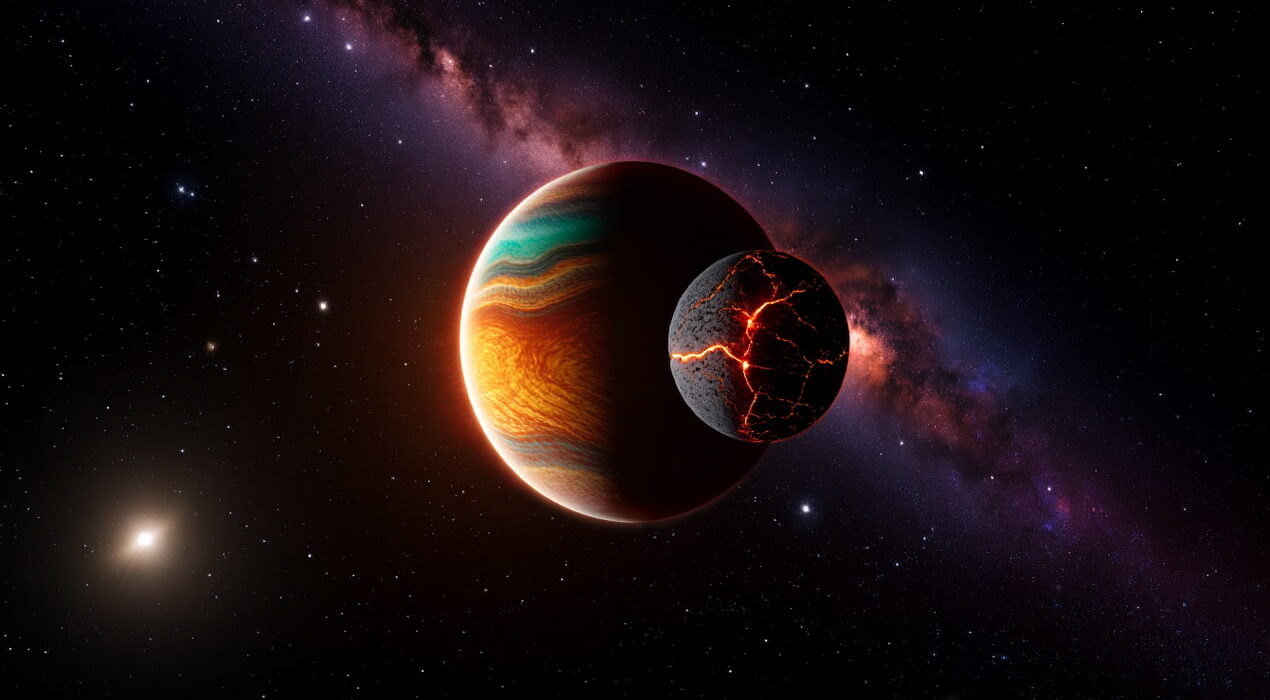
Webb Space Telescope Discovers Rare Planet Pair That Defies Science
Scientists using the James Webb Space Telescope have discovered a rare planet pair unlike anything seen before. The strange system sits about 190 light-years away from Earth. Researchers say the discovery could change current ideas about how planetary systems form.
The unusual system contains a giant hot Jupiter and a smaller mini-Neptune. Normally, hot Jupiters orbit alone because their strong gravity pushes nearby planets away. However, this mini-Neptune survived in a tight orbit close to the star.
Astronomers first discovered the system in 2020. Since then, scientists have tried to explain how both planets managed to remain together. Now, new Webb Space Telescope observations may finally provide the answer.
Webb Telescope Reveals a Strange Atmosphere
Researchers studied the atmosphere of the mini-Neptune using NASA’s powerful Webb telescope. They detected water vapor, carbon dioxide, sulfur dioxide, and traces of methane. Therefore, scientists concluded the planet likely formed far from its star.
Planets forming close to stars usually contain lighter gases like hydrogen and helium. However, this mini-Neptune has a heavy atmosphere rich in icy compounds. As a result, researchers believe the planet formed in a colder outer region before moving inward.
Scientists also think the hot Jupiter and mini-Neptune migrated together over millions of years. During that journey, both planets managed to keep their atmospheres intact. Experts say this discovery provides strong evidence that mini-Neptunes can form beyond a star’s frost line.
Rare Planet Pair Challenges Planet Formation Theories
Astronomers describe this system as one of the rarest planetary arrangements ever discovered. Hot Jupiters usually destroy or scatter nearby planets with their strong gravity. However, this smaller world somehow survived beside its giant companion.
Researchers used detailed orbital models to predict when the planets would pass in front of their star. After careful planning, the Webb telescope captured valuable atmospheric data. Scientists say the success marks a major step in studying distant worlds.
So far, the findings suggest planetary systems across the galaxy may form in many unexpected ways. Future Webb observations could reveal even more unusual cosmic systems.